

Modern web applications no longer only need to respond to a simple URL. Now, they may need to know who the user is, where they are, what's in their cart, or what's happening right now. This kind of personalization and real-time data make dynamic content fundamentally harder to cache than a static image, and that difficulty has real consequences: requests that skip the cache travel further to the origin, adding latency for the user and load for the infrastructure behind it.
This guide covers how dynamic content delivery works, why personalized requests are harder to cache, and how modern CDNs use edge computing, intelligent routing, and selective caching to keep these experiences fast. It'll also demonstrate where a dynamic content delivery network fits into real applications.
Note: If you want to read about CDN fundamentals before diving into dynamic content delivery, check out our other blog post on how a CDN works.
Quick Summary
- Dynamic content delivery allows modern applications to deliver targeted content without sending every request directly to the origin.
- Dynamic CDN delivery combines selective caching, intelligent routing, and edge processing to reduce latency and origin load.
- Cache-key design is critical for personalized content because the CDN needs to distinguish between requests that require different responses while avoiding unnecessary cache fragmentation.
What Is Dynamic Content Delivery And Why Does It Matter?
Dynamic content delivery is the process of delivering content that is generated or modified in response to a specific request, user, or real-time data.
A static file can usually be served the same way to everyone; an image at /products/shoe.jpg looks the same no matter who asks for it. A personalized product page doesn't work that way. Instead, its response depends on the user's account, inventory, location, or past activity.
Common examples of content which falls inside the dynamic content definition include:
- Personalized ecommerce pages
- User dashboards
- Shopping carts
- Account pages
- Search results
- API responses
- Live pricing
- Recommendations
- Location-specific content
Dynamic does not automatically mean uncacheable. A dynamic response can contain some parts that change frequently and other parts that stay stable. Modern architectures take advantage of this by deciding what can be cached, what needs edge processing, and what still has to come from the origin.
Check out FlashEdge's blog post on CDN caching for a deeper dive on the topic.
Static Vs. Dynamic Content Delivery: A Comparison
| Static Delivery | Dynamic Content Delivery |
|---|---|
| Same response served to many users | Response may differ between users |
| Usually highly cacheable | Cacheability depends on the request |
| Served directly from an edge cache | May require edge or origin processing |
| Examples: images, CSS, JavaScript | Examples: account pages, APIs, personalized HTML |
| Low dependency on application state | Depends on databases, auth, or user state |
Why Dynamic Content Is More Difficult To Deliver
The basic CDN model is simple: cache the response close to the user and serve it again on the next request. The problem is that personalized content changes depending on who is asking.
An ecommerce product page can include a wide breadth of information, for example:
- Product information
- Current inventory
- Recommended products
- Loyalty discount
- Shipping country
While some of these details are identical for thousands of visitors, others are unique to one person. Sending every request straight to the origin guarantees the application has what it needs, but it also creates a performance and scalability problem.
- Personalized Requests Create More Variables: Cookies, authorization headers, query parameters, geolocation, and device data can all affect caching, so the CDN needs a carefully designed cache key to identify when requests can share a cached response and when they need different ones. Too many variables create separate cache entries for every combination, while ignoring important variables risks serving the wrong response to the wrong user.
- Server-Side Processing Adds Latency: Cache misses still require a trip to the origin, potentially passing through the application server, APIs, and database before returning to the user. Every hop adds latency, particularly for users far from the origin, and while a CDN can shrink network distance, it cannot eliminate application processing.
- Dynamic Traffic Can Overload The Origin: Uncached dynamic requests still reach the origin, where application servers, APIs, databases, and authentication services must process them. When thousands of users request personalized content at once, this can create a chain reaction:
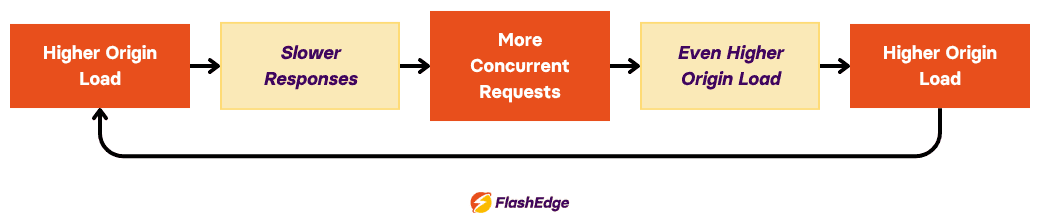
This is why dynamic content delivery depends on application architecture just as much as CDN configuration.
How A Dynamic Content Delivery Network Works
A modern dynamic CDN doesn't have to choose between caching everything and sending everything to the origin. Instead, it can make several decisions throughout the request lifecycle.
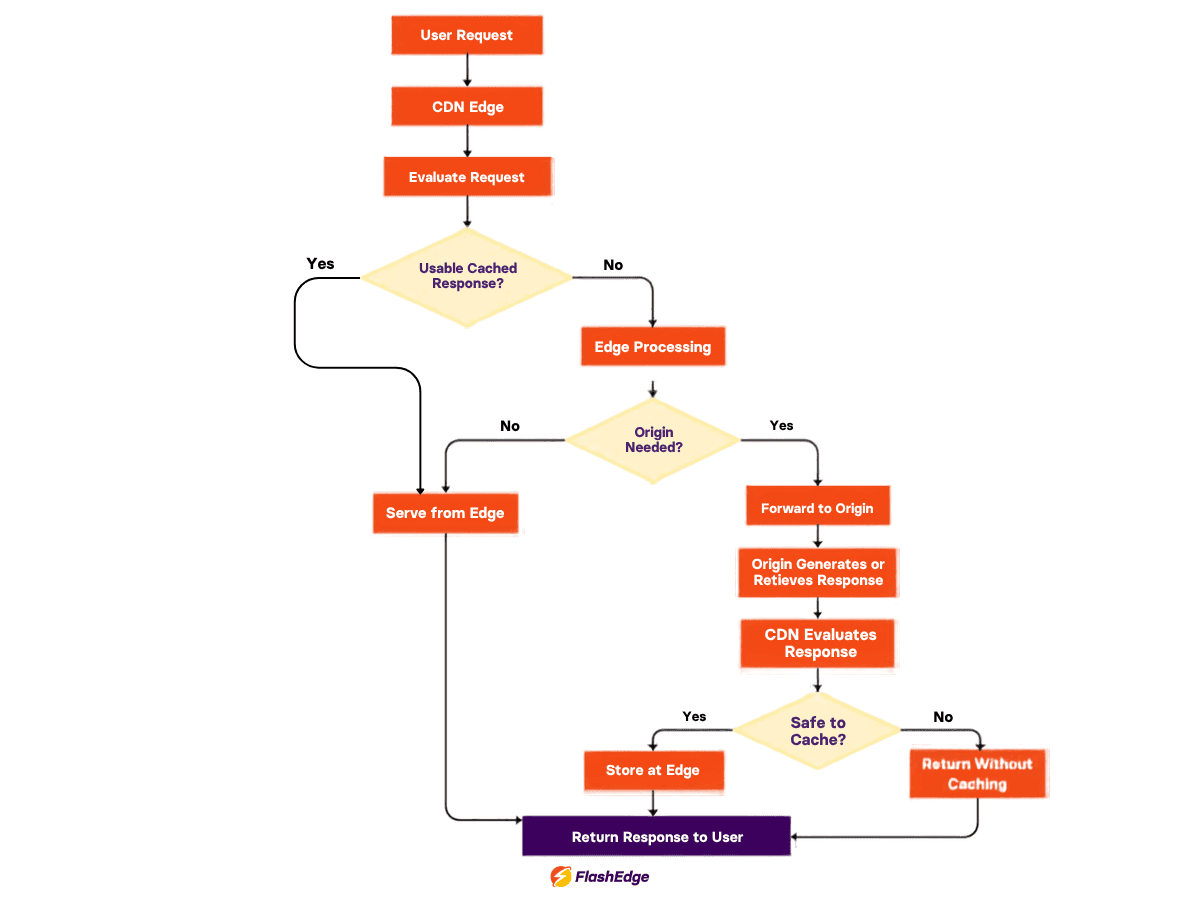
Step 1: Request reaches the edge
When a user requests a page, their request reaches a nearby CDN edge location before going to the origin server. This matters even when the content can't be cached, as it allows the CDN to:
- Decide where the request should go
- Apply security or routing rules
- Modify the request before sending it further
Step 2: CDN evaluates the request
The CDN examines information about the request, such as the URL, HTTP method, query parameters, cookies, headers, and the user's location.
This helps the CDN to identify what the user is asking for and which parts of the request actually matter. Not everything the CDN sees has to become part of the cache key; a cache key is just the information the CDN uses to decide whether two requests are asking for the same thing.
For example, if a cookie contains information that does not affect the response, including it in the cache key could unnecessarily create separate cached versions of the same content.
Step 3: CDN checks the cache
The CDN checks its cache to see whether it already has a usable response. This is where a dynamic CDN's deliberate caching rules come in handy, and why dynamic CDNs can't use a blanket caching setting.
If it finds a response that matches the cache key and is still valid, it serves that response directly from the edge (also called a cache hit). If there is no suitable cached response, the request continues through the delivery process (also called a cache miss).
The important point is that a dynamic CDN does not simply cache or not cache everything. Its caching rules determine which responses can be reused, under what conditions, and for how long.
Step 4: Edge processes the request
Even when the CDN cannot answer the request from its cache, it can still do useful work at the edge. For example, it might:
- Rewrite part of the URL
- Choose which origin should receive the request
- Check a header or cookie
- Apply routing rules
- Perform authentication or authorization checks (where supported)
- Add or remove request information
This means the CDN can handle some of the work that would otherwise have reached the origin. The request is only forwarded when the origin actually needs to generate or retrieve the response.
Step 5: Origin generates the response
If the CDN can't satisfy the request itself, it forwards it to the appropriate origin. The origin could be a traditional web server, application, API, serverless function, or object storage service. The origin then does whatever work is necessary to produce the response.
For a personalized account page, for example, the application might need to identify the user, retrieve their data from a database, and generate the appropriate response.
Step 6: CDN decides what happens next
Once the origin responds, the CDN determines whether to cache it, for how long, and under which key. If the response is safe to reuse, the CDN can store it at the edge and serve it to future matching requests. It might keep that response for a few seconds, several minutes, or longer depending on how frequently the content changes and how it is configured.
If the response contains private or highly personalized information, the CDN may decide not to cache it at all. It can simply pass the response back to the user.
This is where good caching rules matter. The CDN needs to know when two requests can safely share a response and when they need to be handled separately.
Essentially, the CDN isn't simply deciding between cache and origin. It is deciding what work can be done at the edge, what can be reused, and what still needs to reach the origin.
Technologies That Power Modern Dynamic Content Delivery
Modern dynamic content delivery relies on several technologies working together. No single feature solves the problem on its own; the architecture is about placing the right work in the right location.
- Edge computing brings application logic closer to the user instead of routing every decision to a centralized origin, and it works best for small pieces of logic rather than entire backends.
- Intelligent routing determines where a request should go once it cannot be satisfied at the edge, accounting for network performance, geography, origin health, and current traffic.
- Serverless execution provides application logic without a permanently running server, useful for request transformation, personalization, and lightweight API processing.
- Origin shielding adds a caching layer between edge locations and the origin, so multiple edges pull an object once instead of each hitting the origin separately.
- Selective caching caches the parts that can be cached, whether that is static assets, shared dynamic content, or region- and user-specific content, and treats each differently.
A modern CDN like FlashEdge exists to coordinate these technologies, turning them into a single delivery path rather than disconnected pieces.
Dynamic CDN Content Caching: What Can Actually Be Cached?
CDN dynamic content can still be cached when the CDN understands what makes one response different from another. "Dynamic content" sounds uncacheable, but in practice the opposite is often true.
| Content | Typical Strategy |
|---|---|
| Product images | Long-lived edge caching |
| Product descriptions | Cache with controlled TTL |
| Regional pricing | Cache by region where appropriate |
| Inventory | Short TTL or live API request |
| Shopping cart | Usually private or uncached |
| Account information | Private, authenticated request |
| Recommendations | Application or edge logic |
Cache keys have to match personalization. This is particularly important for personalized content delivery, where seemingly small differences between requests can determine whether responses can safely share a cache entry.
- If a page changes based on the Accept-Language header and the CDN ignores that header, users can receive content meant for someone else.
- If it includes every header in the cache key, the number of variants can explode.
The fix is identifying the set of attributes that change the response, which is why cache policies and origin request policies are usually treated as separate concepts: one shapes the cache key, the other passes information to the origin without creating a new variant.
Common Use Cases For Personalized Content Delivery
- Ecommerce: a CDN caches reusable product content while routing authenticated or real-time requests, like cart and checkout, straight to the application.
- SaaS dashboards: the dashboard itself is dynamic, but the assets around it are highly cacheable, so the CDN handles those at the edge while accelerating API traffic.
- Media and streaming: large static files, like video segments, can be cached, while metadata about recommendations or playback state usually needs application logic.
- Financial and data applications: shared resources and API responses can be cached where consistency allows it, but for time-sensitive data, edge routing often matters more than caching the response itself.
- Real-time applications: live scores, chat, notifications, and market data rely on WebSockets, server-sent events, or frequent polling. Real-time content delivery does not necessarily mean caching the response; a CDN can still help through routing, connection management, and proximity to users.
Best Practices To Deliver Targeted Content Efficiently
- Classify content first: separate what the application serves into public and reusable, public but frequently updated, personalized, private, and real-time, rather than treating the whole site as one category.
- Keep cache keys small: only include attributes that genuinely change the response, since unnecessary cookies and query parameters fragment the cache, but never strip an attribute that actually affects output just to raise the hit ratio. Getting these rules right starts with careful CDN configuration, particularly around caching, origins, and request handling.
- Set TTLs by behavior, not habit: consider how often the data changes, how costly a stale response would be, and how expensive an origin request is, since a product description can tolerate a longer TTL than live inventory.
- Keep personal data out of shared caches: a shared cache must never serve one user's private response to another. Review authentication headers, session cookies, and cache-control directives together.
- Measure beyond cache hit ratio: track time to first byte, origin response time, error rate, and API latency alongside hit ratio, since a strong hit ratio can still hide a slow uncached path.
- Design the origin for cache misses: connection pooling, database optimization, and horizontal scaling matter because the CDN reduces pressure on the origin, but it doesn't remove the need for the origin to perform well.
The Future Of Dynamic Content Delivery Is More Distributed
Dynamic content delivery isn't just about caching everything. It's more about understanding which parts of an application should happen where. This distinction matters most at scale, for example for organisations handling large volumes of dynamic traffic; in those cases, every added millisecond of latency compounds across millions of user sessions.
FlashEdge is designed to address this challenge. By combining intelligent routing, edge compute, and origin shielding, FlashEdge handles the split between what can move to the edge and what still needs to reach the origin. This allows dynamic applications to stay fast without overloading backend infrastructure.
Try a free trial or contact one of our technicians today to find out how FlashEdge could help your organization deliver dynamic content more smoothly.
Frequently Asked Questions About Dynamic Content Delivery
What Is Dynamic Content Delivery?
It is the process of delivering content generated or modified according to a request, user, or real-time data. A CDN speeds this up through selective caching, edge processing, and intelligent routing.
Can A CDN Cache Dynamic Content?
Yes, when the response is safe to reuse and the cache configuration correctly accounts for what affects it. Many CDNs also use edge computing to generate or modify content closer to the user.
How Does A Dynamic CDN Handle Personalized Content?
It identifies which parts of a request actually determine the personalized response. Some content can be cached by attribute, such as region or language, while other content bypasses the shared cache entirely and reaches the application.
What Is The Biggest Challenge With Dynamic CDN Delivery?
Deciding what can safely be reused. The architecture has to balance cache efficiency, personalization, freshness, and security, since poor cache-key design creates unnecessary misses and overly broad caching can expose private content.
Explore Related Articles
➡️Dynamic Content Caching: How It Works, Benefits & Best Practices
Explore which dynamic responses can be cached, how cache keys distinguish variants, and when short TTLs or microcaching make sense.
➡️Complete Guide To HTTP Cache Headers And Their Types
Understand how private, no-store, Vary, and validation headers help control cache storage, response variants, and freshness.
➡️Application Performance Optimization: A Complete Guide to Faster, More Scalable Applications
Investigate the application work behind uncached responses with approaches for locating bottlenecks, optimizing backend and database performance, and validating improvements.