
CDN performance affects how quickly users receive content, how much work your origin handles, and how consistently your application performs across regions. However, CDN performance is about more than just having a large network or advertising low latency.
This guide explains the factors that determine CDN speed, which CDN performance metrics matter, how to measure and optimize them, and how to make a fair CDN performance comparison when choosing a provider.
Quick Summary
- CDN performance can't be measured with a single number. Other factors like cache hit ratio, TTFB, latency, error rate, origin fetch rate, and regional performance all need to be considered together.
- Vendor benchmarks can be misleading because they often use different locations, cache states, or testing methods, so a fair comparison requires testing providers under identical conditions.
- Performance is specific to your workload: what matters most for an API differs from what matters most for ecommerce, streaming, or SaaS, so testing should reflect your actual use case.
- Before switching providers, check your own configuration first. Cache keys, TTLs, and cache-control headers are frequently the fastest way to improve results.
What Is CDN Performance and Why Does It Matter?
CDN performance describes how effectively a content delivery network serves content. It includes response time, latency, cache efficiency, reliability, and consistency across regions.
A CDN improves performance by moving content closer to users and serving cached resources from edge locations. Good CDN performance can provide:
- Faster response times and a better user experience
- Lower origin load and bandwidth usage
- Better scalability during traffic spikes
- More consistent delivery across regions
The impact depends on the application. CDN speed matters differently for an ecommerce site, SaaS application, API, or streaming platform, so performance should be measured against your actual workload.
What Affects CDN Performance?
Several parts of a CDN's architecture influence how quickly a request reaches the user.
Edge Locations, Network Connectivity, and Routing
The distance between a user and an edge location affects latency. More locations can improve geographic coverage, but location count alone doesn't guarantee better performance. Network connectivity, routing, and peering with regional ISPs also matter, since two CDNs with a similar number of edge locations can still perform differently depending on how well their network interconnects with users' ISPs.
Anycast routing directs requests according to internet routing decisions, although the physically closest edge location is not always the fastest path.
Cache Efficiency and Origin Performance
A cache hit allows the CDN to return an object without contacting the origin, while a cache miss adds an origin request and additional latency. As a result, cache keys, TTLs, cache-control headers, and invalidation strategies all affect CDN performance.
💡 Note: MDN's HTTP caching documentation looks at HTTP caching in further depth.
You also need to consider origin performance; whichever CDN you choose, your application still needs to spend time processing uncached responses.
CDN Performance Metrics That Actually Matter
A single number rarely gives you a useful picture of CDN performance. These CDN performance metrics should be considered together.
| Metric | What It Measures | What Influences It | How To Act On It |
|---|---|---|---|
| Cache Hit Ratio | Percentage of requests served from cache instead of origin | Cache-control headers, cache keys, and TTLs | If the ratio is lower than expected, review those three settings first |
| TTFB | Time until the first response byte arrives | Edge, network, or origin performance | Compare cache hits and misses separately and break TTFB into network, edge, and origin components where possible |
| Latency | Time associated with network communication between the client, CDN edge, and origin | Distance, routing, ISP connectivity, and congestion | Compare results by region rather than relying on a global average |
| Error Rate | Percentage of failed requests | Where the failure originates: edge, network, or origin | Monitor by region, endpoint, and status code to narrow it down |
| Origin Fetch Rate | How often requests reach the origin instead of being served from cache | Cacheability, TTLs, cache keys, and request patterns | Review those factors if the rate is higher than expected |
| Regional Performance | How consistently the CDN performs across locations | Edge coverage, routing, peering, and regional cache behavior | Prioritize the markets where your users are actually located |
How To Measure CDN Performance Reliably
A useful CDN performance test should reflect how your application is actually used. Before testing, define:
- Geographic regions that matter to your users
- URLs and content types
- Cache-hit and cache-miss scenarios
- Typical request volume
- Metrics you will compare
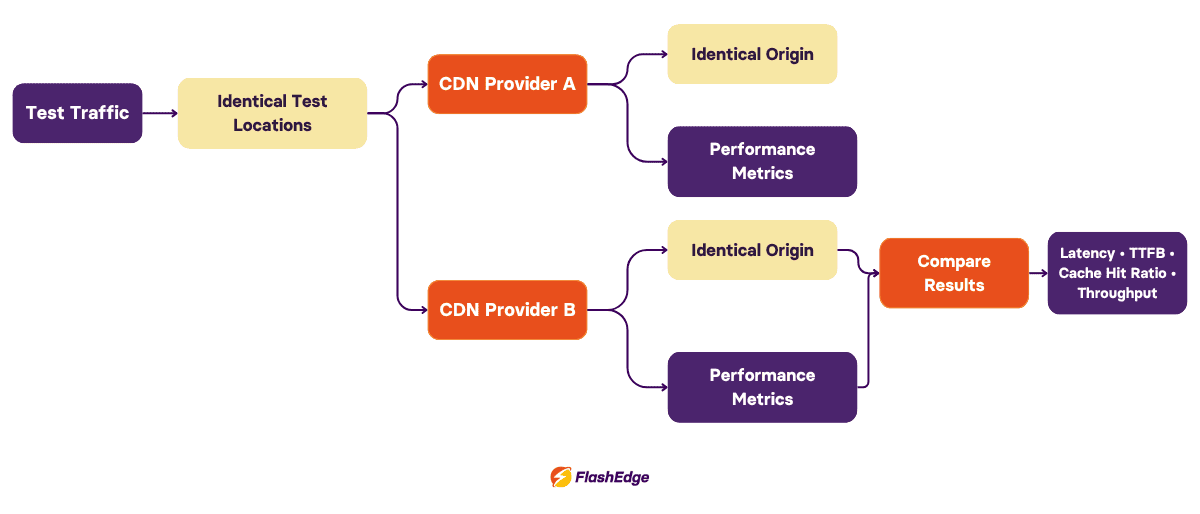
Use the same content, cache configuration, request volume, and test locations when comparing providers. Run multiple tests and compare results over time rather than relying only on averages, which can hide inconsistent performance. Separate cache hits from cache misses to distinguish edge delivery from origin performance.
| Test | What It Shows |
|---|---|
| Cache hit | Edge and network delivery |
| Cache miss | Origin and CDN-to-origin performance |
| Multiple regions | Geographic consistency |
| Repeated requests | Cache behavior |
| Error monitoring | Reliability |
For cache-based tests, distinguish cold-cache behavior from steady-state performance and document whether the test represents a warmed or newly populated cache.
If you want more information, FlashEdge has a deep dive on how to measure your network performance.
CDN Performance Comparison: How To Evaluate Providers Fairly
A CDN performance comparison is only useful when providers are tested under comparable conditions.
When vendors state their benchmarks, they could be referring to any different location, cache state, content size, or testing method, so comparisons between CDN benchmarks tend to be misleading.
A fair CDN performance comparison should consider:
| Factor | What To Compare |
|---|---|
| Latency and TTFB | Regional response times |
| Cache performance | Hit ratio and origin fetches |
| Reliability | Error rates |
| Geographic coverage | Relevant user regions |
| Network quality | Routing and connectivity |
| Configuration | Cache rules and TTLs |
| Cost | Bandwidth, requests, and services |
💡 Note: FlashEdge's guide to Top CDN Providers compared contains our analysis and further information on making a fair comparison between CDNs.
Why Cache Keys Matter In a CDN Performance Comparison
Cache-key configuration can significantly affect results.
- Unnecessary query parameters, cookies, or headers can create separate cache entries and reduce the hit ratio.
- Removing a value that changes the response can cause incorrect content to be served.
The basic rule of thumb is: include values that genuinely change the response and exclude those that do not.
Focus CDN Speed Comparison On Relevant Regions
A global average can hide poor performance in an important market. If most users are in Europe, European performance should have more influence on your decision than regions representing little traffic.
CDN Performance For Different Workloads and Use Cases
The best CDN for one workload may not be the best for another.
| Use Case | What To Prioritize |
|---|---|
| SaaS | API latency, caching controls, consistency |
| Ecommerce | Product caching, APIs, personalization |
| APIs | Latency, microcaching, cache-key controls |
| Media & Streaming | Throughput, coverage, consistency |
| Gaming | Asset delivery, API latency, regional performance |
| Global Enterprise | Reliability, coverage, monitoring |
- SaaS applications combine static assets, APIs, and personalized responses, so test asset delivery separately from APIs.
- Ecommerce platforms can cache product information and images, while inventory, carts, and checkout require more careful handling.
- APIs may benefit from short-lived caching or microcaching to reduce repeated origin requests without allowing data to become excessively stale.
- Streaming workloads depend heavily on throughput, coverage, and delivery consistency, while gaming can combine large asset downloads with latency-sensitive APIs.
- Global organizations should prioritize regional performance, reliability, network coverage, operational controls, and monitoring.
How To Optimize CDN Performance
A poor CDN performance result doesn't automatically mean you should change provider; take a look at your configuration first.
Improve Cache Hit Ratio
Identify content that could safely be cached but is still reaching the origin. Review cache keys, TTLs, cookies, query parameters, and cache-control headers.
Avoid unnecessary values in the cache key, as too many variations can fragment the cache and reduce hit rates.
See FlashEdge's CDN Optimization Strategies for more caching techniques.
Reduce Unnecessary Origin Requests
Short-lived caching can help with frequently changing content. The correct TTL depends on how much staleness the application can tolerate. A public API response that changes every minute may benefit from a short cache period, while a versioned JavaScript file can usually be cached much longer.
Improve Regional CDN Speed
If users in one region consistently experience higher latency, investigate:
- Edge coverage
- Network routing
- ISP connectivity
- Peering
- Origin location
- Regional cache behavior
Optimize Content and Monitor Results
A CDN can't compensate for unnecessarily large responses. Compression, efficient image formats, smaller JavaScript bundles, and sensible asset versioning can reduce transfer time.
After making changes, measure the same CDN performance metrics again and track cache hit ratio, TTFB, latency, errors, origin fetch rate, and regional results over time.
FlashEdge's CDN Configuration Guide offers further configuration guidance.
CDN Performance Is A Workload-Specific Measurement
There is no universal CDN performance score that tells you which provider is best.
A CDN could perform extremely well for static assets but less well for an API-heavy SaaS application. Another could perform well in North America but less effectively in a region where your business is growing.
The most reliable approach is to:
- Define the performance characteristics that matter to your application.
- Test providers using the same conditions.
- Compare multiple CDN performance metrics across relevant regions.
- Monitor results after deployment.
This gives you a more useful basis for choosing a CDN than relying on a single vendor benchmark.
Conclusion
CDN performance depends on cache efficiency, TTFB, latency, routing, reliability, origin performance, and regional consistency. A useful CDN performance comparison is based on its performance with your own infrastructure and use case.
Testing these factors also highlights the areas where optimization can have the biggest impact; once you've tested, you may find that improving cache efficiency or reducing unnecessary origin requests could deliver better results than switching providers.
FlashEdge CDN provides flexible caching and delivery controls for different application requirements, allowing teams to optimize delivery around their workloads and performance goals. Sign up for an instant free trial to test out FlashEdge in your environment right away, or reach out to our engineers for advice and a trial tailored more specifically to your infrastructure.
Frequently Asked Questions
What is CDN performance?
CDN performance describes how effectively a CDN delivers content, including response time, latency, cache efficiency, reliability, and regional consistency.
Which CDN performance metrics matter most?
Cache hit ratio, TTFB, latency, error rate, origin fetch rate, and regional performance provide a useful overall picture.
How do you measure CDN performance?
Test the same content and configuration from multiple locations. Measure cache hits and misses separately and repeat tests over time.
What affects CDN speed?
Network distance, routing, edge location, cache status, origin response time, congestion, and CDN configuration can all affect CDN speed.
Does more edge locations mean better CDN performance?
Not necessarily. Geographic coverage matters, but network quality, routing, cache behavior, and user distribution also affect performance.