
CDNs are powerful tools, but for a CDN to be productive its settings need to be carefully tweaked to suit your environment. Poor cache settings, inefficient routing, and unnecessary origin requests can affect the performance of your CDN (and your infrastructure budget) despite being technically "switched on". Especially for users who work with APIs, streaming, or dynamic content, the difference between a CDN that has only been activated and a CDN that has been optimized is very noticeable. This article will show you how to close that gap.
Quick Summary
- Boost CDN performance by increasing cache hit ratios and reducing unnecessary origin requests
- Reduce global latency with edge caching, origin shielding, and intelligent routing
- Improve API and dynamic content delivery using microcaching and stale-while-revalidate strategies
- Lower infrastructure costs by offloading more traffic from backend servers
- Measure success with cache hit ratio, Time to First Byte (TTFB), origin offload percentage, and Core Web Vitals
What is CDN optimization?
CDN optimization is about configuring your CDN to do its job as effectively as possible, which means faster performance, lower latency, and less pressure on your origin server. A CDN helps things load faster by caching content at edge locations closer to your users, but modern applications mix multiple types of content which each have different delivery needs–for example; APIs, personalized content, and streaming traffic. Basic caching only really handles half of the picture.
Benefits of CDN optimization
Speed your users notice
Good CDN configuration reduces Time to First Byte (TTFB) and makes web apps, SaaS platforms, and APIs feel instant. While users may not have the terminology "TTFB", they certainly notice when something feels slow (and depending on how slow, they may even leave). For more information on TTFB, check out FlashEdge’s blog post with details about how to reduce it.
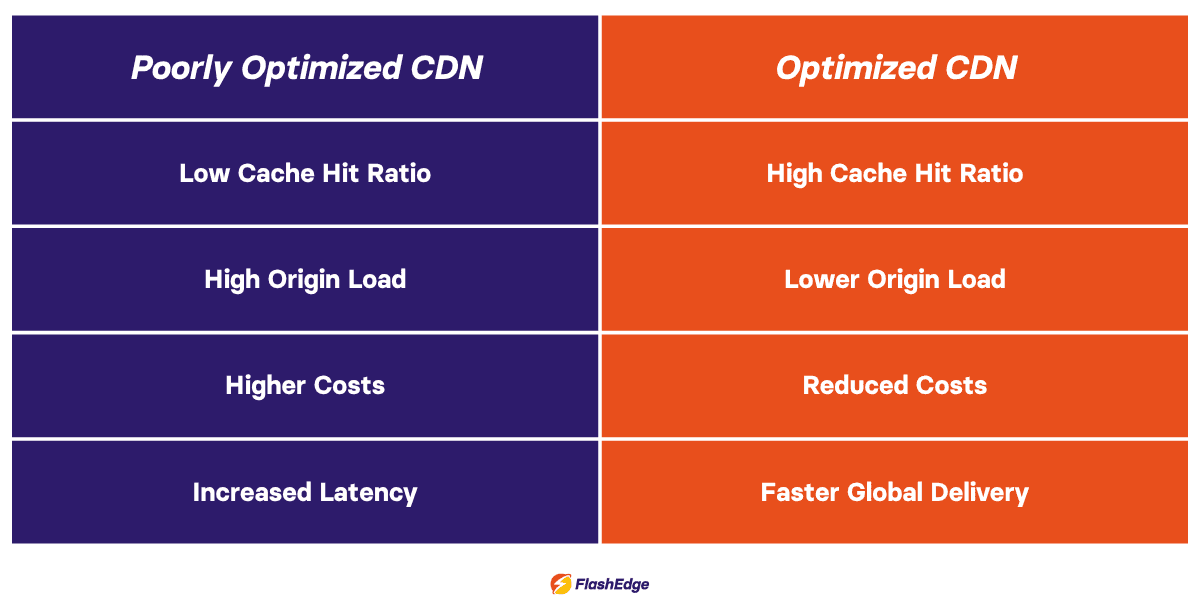
Lower infrastructure costs
A poor cache hit ratio means more requests bouncing back to your origin. If you fix the caching you can reduce bandwidth, backend load, and compute costs. Learn more about cache hit ratios in FlashEdge’s blog post.
Consistent global performance
Optimized edge delivery means users get content from the nearest Point of Presence, not wherever the routing lottery lands them. If you’re interested, FlashEdge has a whole article on Points of Presence (PoP)—check it out to learn more.
5 strategies to optimize your CDN
1. Improve Cache Hit Ratio
This is the most significant optimization step you can take. This is where most of the gains are. Extend TTL values for static assets, strip unnecessary cookies from cache keys, normalize query strings, and use immutable asset versioning. Each of these means fewer requests reaching your origin and faster delivery for everyone. A common best practice is to set a cache TTL of up to one year for versioned static assets such as JavaScript bundles, CSS files, and images. Because the filename changes whenever the asset is updated, the CDN can safely cache it for long periods while ensuring users always receive the latest version.
2. Cache Dynamic Content, Too
Just because content is dynamic doesn't mean it can't be cached. Modern CDNs support API response caching, stale-while-revalidate, microcaching, and edge logic for personalized content. If it's well set up, this can take pressure off your backend without affecting user experience. An API endpoint that serves product catalogs, pricing information, or public content can often be microcached for 30–60 seconds; even short cache durations can significantly reduce backend load during traffic spikes while keeping content fresh for users.
3. Add Origin Shielding
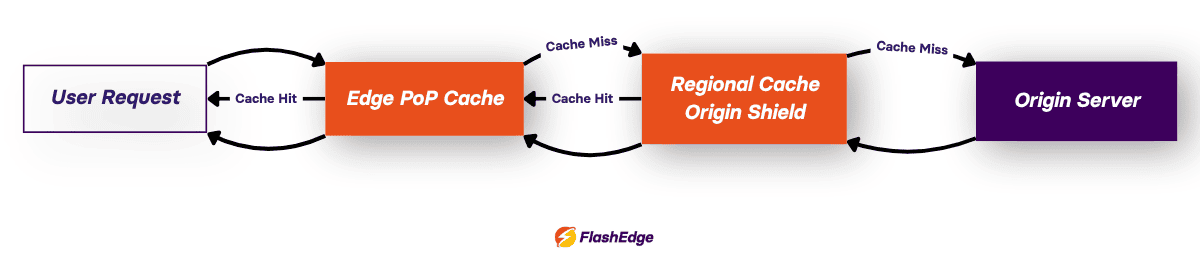
Origin shielding puts an extra cache layer between your edge nodes and your origin server. The outcome is fewer duplicate fetches, lower bandwidth costs, and better resilience when traffic spikes. FlashEdge uses regional edge caches for exactly this reason.
4. Compress and Optimize at the Edge
Smaller files load faster. Brotli or Gzip compression, WebP or AVIF image conversion, and CSS/JS minification all reduce transfer size immediately. These optimizations don't require big architectural changes, but they reliably cut load times on both desktop and mobile; for example, converting images from JPEG or PNG to WebP can often reduce file sizes by 25–35% without noticeable quality loss. Similarly, Brotli compression typically achieves better compression ratios than Gzip for text-based assets such as HTML, CSS, and JavaScript.
For readers who want a deeper technical explanation of modern image formats like WebP and AVIF—and why they reduce transfer size so effectively—Mozilla’s MDN documentation provides a useful overview.
5. Monitor Continuously
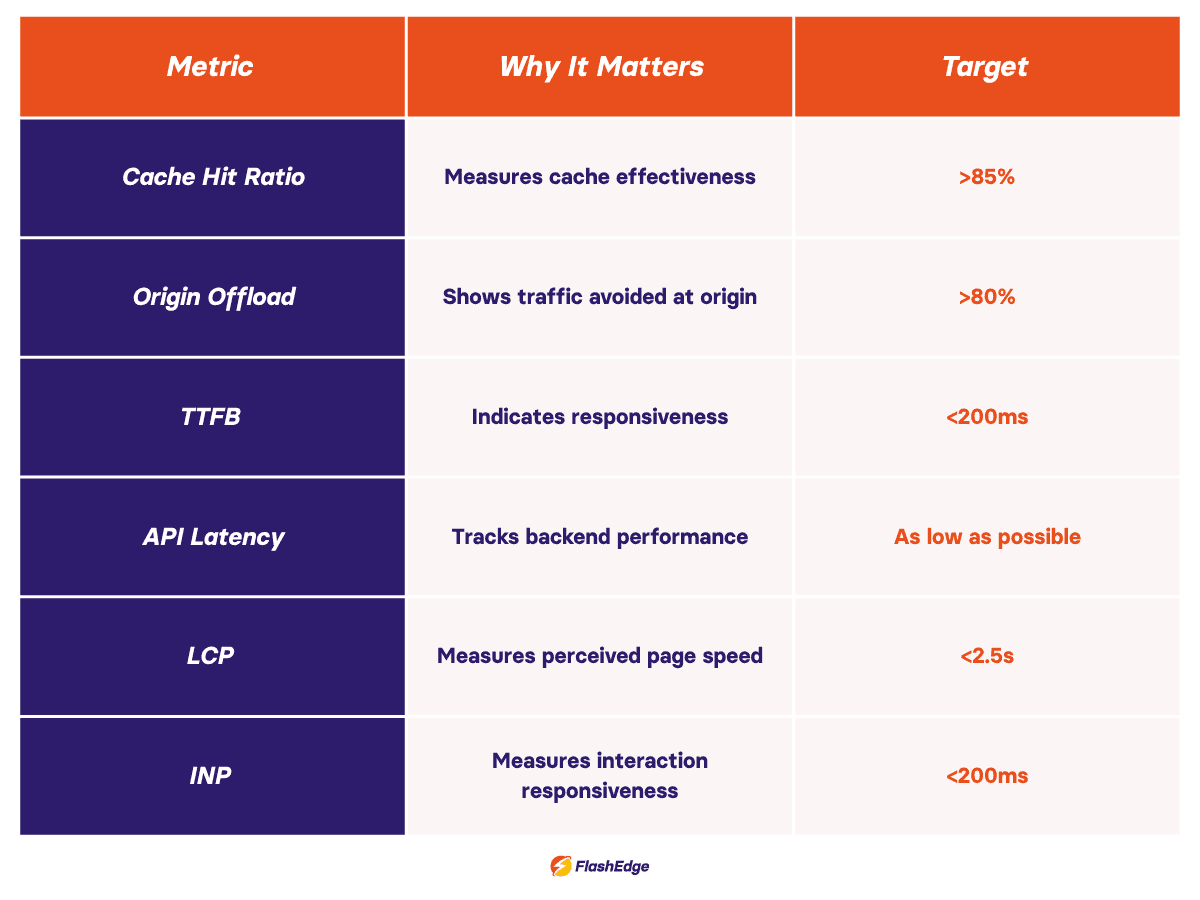
Optimizing your CDN isn't only crucial when you initially set it up. It's important to keep monitoring cache hit ratio, origin offload percentage, API latency, Core Web Vitals, and geographic response times; this will ensure you catch weaknesses or bottlenecks before they become globally visible to your users. As a general benchmark, many organizations aim for a cache hit ratio above 85%, although the ideal value depends on the type of application and the amount of dynamic content being served.
What to track
So how can you tell how effectively your CDN is working? By tracking the following:
- Cache hit ratio (the higher the better)
- Origin offload
- TTFB and API response times
- Core web vitals like LCP and INP
If those numbers show improvement, you know that your optimization is working effectively.
Optimizing your CDN is a necessary step
Properly tuning your CDN is an investment with a high payoff. With better cache efficiency, smarter dynamic delivery, reduced origin dependency, and solid monitoring, you can benefit from faster experiences and lower costs. For modern applications, CDN optimization–and, more broadly, content delivery optimization– is no longer optional; it's crucial to deliver a reliable product worldwide.
While many optimization techniques can be implemented regardless of your CDN provider, the platform itself plays a major role in the results you achieve. A globally distributed network, intelligent caching infrastructure, strong security, and easy access to performance insights can significantly reduce the effort required to improve content delivery.
FlashEdge CDN combines a global network of more than 400 Points of Presence, built-in DDoS protection, seamless AWS integration, and support for both static and dynamic content delivery. If you're looking for a simpler way to improve performance and reduce latency worldwide, start a free trial or get in touch with our team.

FAQs
What is CDN website optimization?
CDN optimization is when you configure a CDN to ensure it is caching and delivering content more efficiently, reducing latency and origin load. It’s about ensuring your CDN is providing the most value it can.
Why does cache hit ratio matter?
When more requests are served from the edge, you’ll experience reduced origin traffic. In turn, this leads to lower latency and reduced backend pressure. This is essentially what CDNs were designed to do.
Can CDNs cache dynamic content?
Yes—API caching, microcaching, and edge logic make it very doable to cache dynamic content.
How do you measure CDN optimization success?
Common CDN performance metrics include cache hit ratio, origin offload percentage, latency, API response times, and Core Web Vitals. Improvements in these metrics typically indicate that your optimization efforts are working.