
When researching content delivery infrastructure, you'll see a lot of terms used casually with very little clarity on their definitions; for example, "edge CDN", "edge server", "edge computing CDN". In this article we'll clarify what an edge CDN is, how it works, how it differs from more traditional CDN deployments, and explain how edge computing fits into the picture.
Quick Summary
- An edge CDN serves content from servers positioned as close as possible to end users, reducing latency by shortening the path content has to travel.
- Modern edge CDNs go beyond traditional CDNs with larger footprints, smarter caching, real-time routing, and integration with edge computing.
- CDN and edge computing are related but distinct: CDN focuses on content delivery, edge computing on running application logic at distributed locations.
- Whether an edge CDN is the right fit depends on your workload type, user distribution, and latency requirements.
What is an edge CDN?
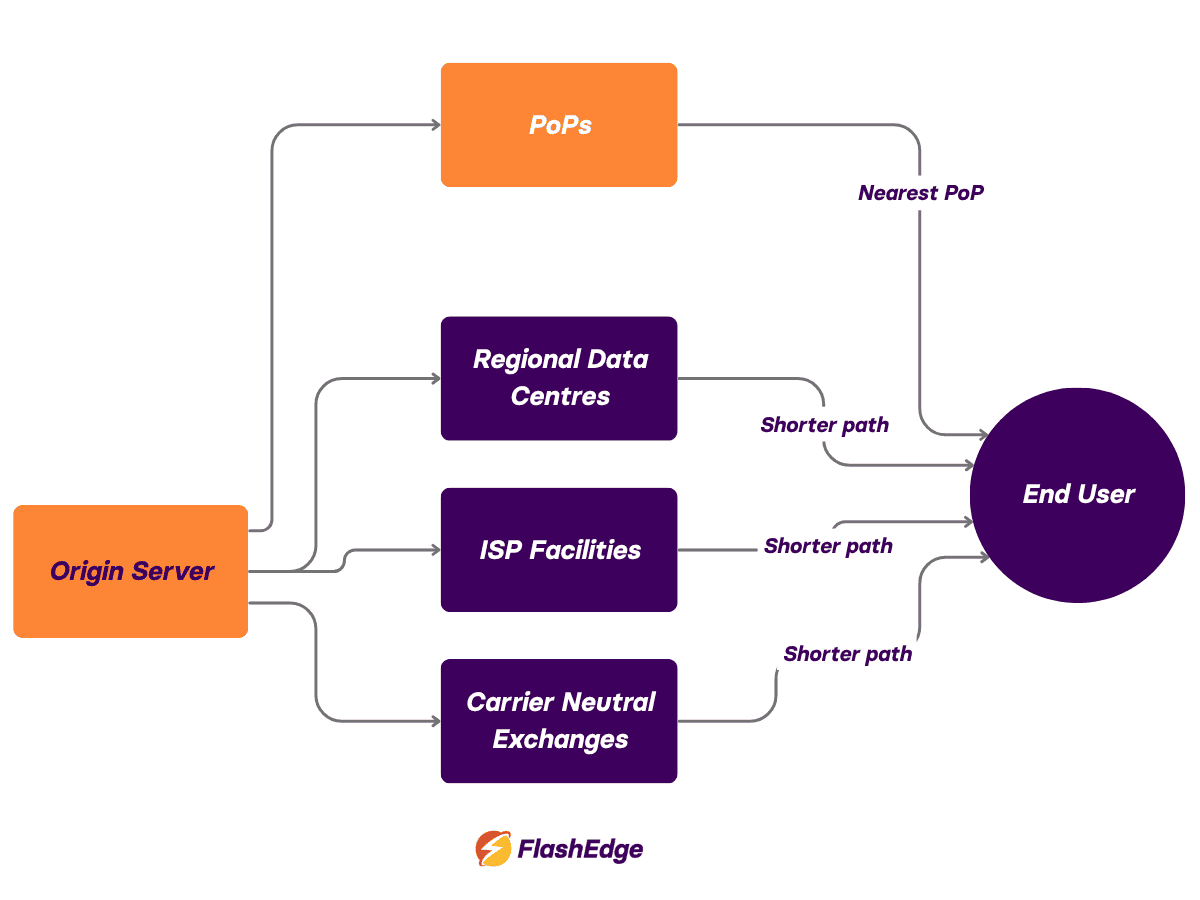
An edge CDN is a content delivery network that serves content from geographically distributed edge nodes using a combination of DNS-based routing and Anycast routing to reduce latency and offload origin servers. In a standard CDN, an origin server distributes content to a set of caching nodes called Points of Presence (PoPs). Requests are served from the nearest PoP rather than the origin, reducing round-trip time and offloading traffic.
An edge CDN extends this model by deploying a denser network of edge locations, often including ISP facilities, carrier-neutral exchanges, or regional data centres that sit closer to end users. The result is shorter network paths, lower latency, and better reliability for content-heavy applications.
As applications have grown more complex and demanding, edge CDN deployments have become increasingly important. Static websites can often tolerate higher latency than interactive applications, but video streaming, real-time APIs, and interactive applications cannot.
How does an Edge CDN work?
Delivering content through edge locations
When a user makes a request, DNS or Anycast routing directs the request toward an appropriate edge location. DNS-based systems resolve the domain to a region-optimized edge endpoint. Modern edge CDNs often use anycast routing, where multiple servers share the same IP address and the network automatically directs traffic to the best available edge location based on internet routing. If the edge server has the resource cached, it returns it immediately. If not, it fetches from the origin, caches it, and returns it to the user.
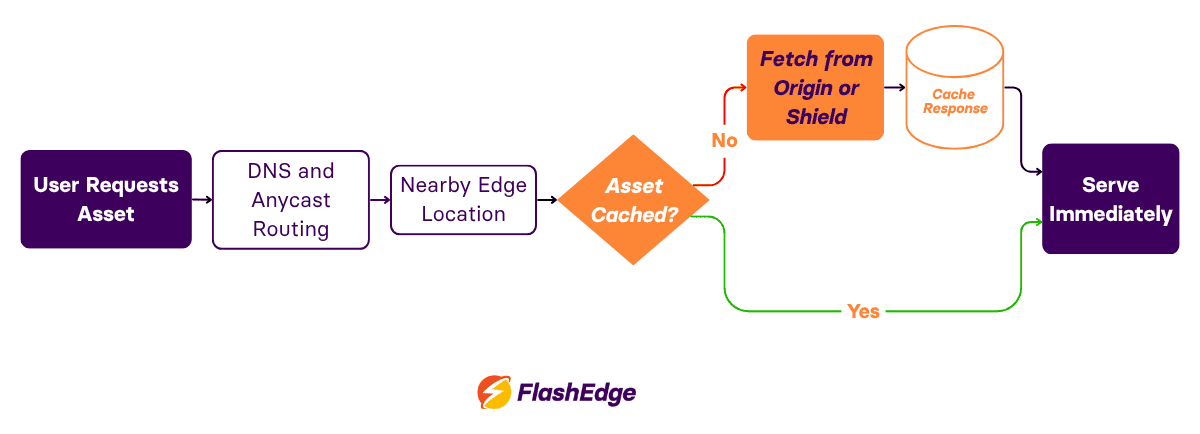
The whole process looks like this:
- User requests an asset.
- DNS and Anycast direct the request to a nearby edge location.
- If the asset is cached, it is served immediately.
- If not, the edge fetches it from the origin (or an origin shield).
- The response is cached according to policy for future requests.
Caching content closer to users
Effective caching at the edge involves more than storing files nearby. Key mechanisms include:
- Cache-Control headers: Define how long content is stored and whether stale content can be served while revalidating in the background.
- Stale-while-revalidate: Serves a slightly outdated response while fetching a fresh version in the background.
- Origin shielding: A regional edge node acts as an intermediary layer between outer edge servers and the origin, concentrating cache misses and reducing origin load.
- Request coalescing: Multiple simultaneous requests for the same uncached resource trigger only one origin fetch, protecting against cache-miss spikes.
Intelligent routing across the edge distribution network
CDN edge networks constantly monitor factors like latency, packet loss, and available bandwidth using a combination of Anycast routing (BGP path selection), DNS steering (GeoDNS or latency-based routing), and real-time telemetry to route traffic to the optimal edge node. Some providers also operate private backbone networks, allowing traffic to travel across their own infrastructure instead of relying solely on the public internet. By avoiding congested routes, they can reduce jitter, minimize packet loss, and deliver more consistent performance than standard BGP routing alone.
Aren't all CDNs already edge-based? CDN vs Edge
All CDNs use distributed servers, so the distinction between more "traditional" CDNs vs more recent edge CDNs comes down to capability. There is no universally accepted distinction between a 'traditional CDN' and an 'edge CDN'. Most modern CDNs already operate at the network edge. Today, the term usually refers to platforms with denser edge deployments and additional capabilities beyond basic caching.
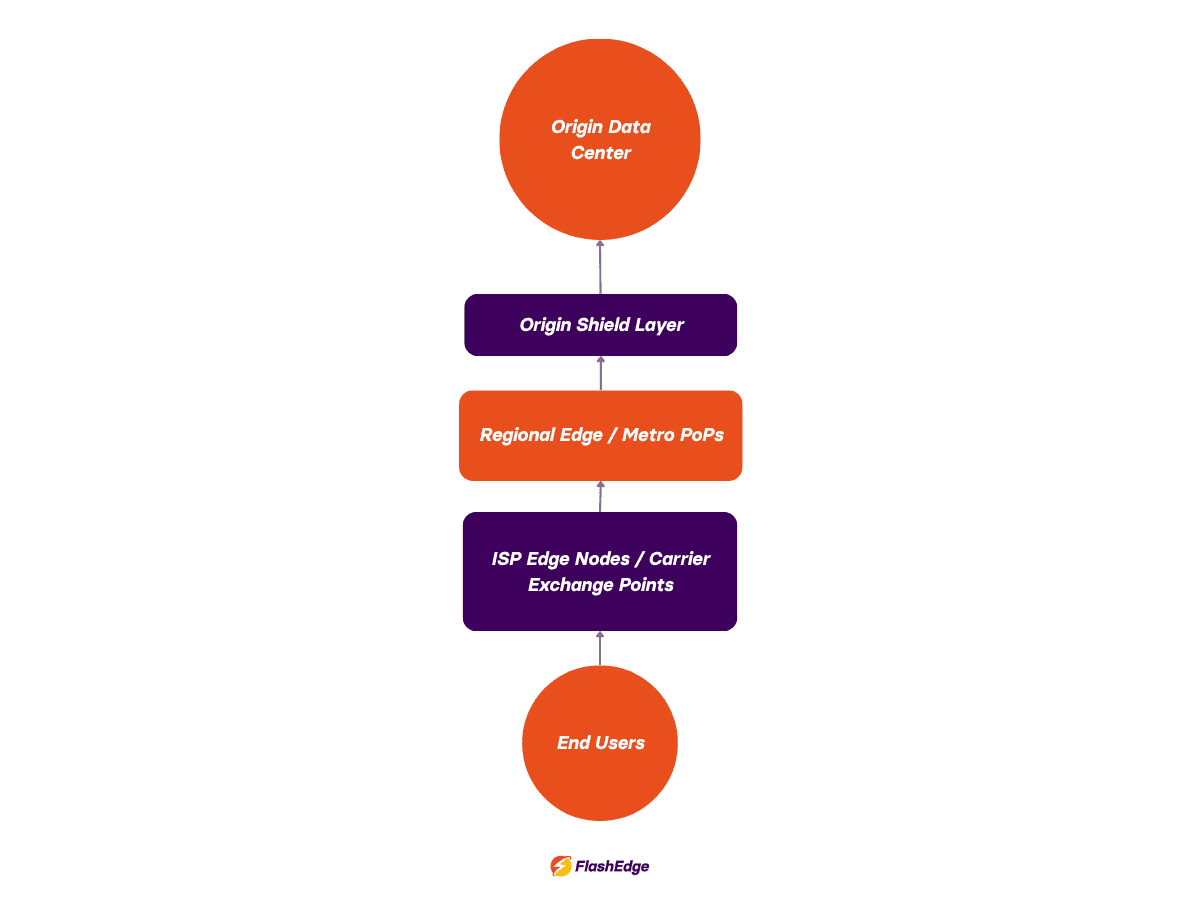
Early CDNs were built for static content delivery from PoPs at major internet exchange points, with dozens to hundreds of locations globally. Modern edge CDNs go further in several ways:
- Larger footprints: Hundreds or thousands of smaller edge locations in regional ISP and carrier-neutral facilities, not just major internet hubs.
- Advanced caching: Programmatic cache control, per-request logic, and fine-grained TTL management beyond header-based caching.
- Dynamic content acceleration: Persistent connections, TLS session resumption, HTTP/2 and HTTP/3 multiplexing to reduce overhead on non-cacheable content.
- Edge compute integration: Code runs directly at edge nodes, blurring the boundary between content delivery and application execution.
CDN edge and edge computing: what is the difference?
The terms CDN and edge computing are frequently used interchangeably, but they have distinct definitions. A CDN is a distributed caching and delivery system optimized for serving static and cacheable content from edge locations, reducing latency by minimizing origin round trips. Edge computing refers to executing application logic at distributed edge nodes, enabling operations such as authentication, request transformation, personalization, A/B testing, bot filtering, and routing decisions to occur closer to the user instead of a central origin.
The difference between CDN and edge computing is rooted in what happens at the node: serving cached content versus executing code. In practice, the line is blurring. Modern CDN edge platforms increasingly offer edge functions that run lightweight code at the same nodes that serve content. For infrastructure decision-makers, this means choosing a CDN edge provider today often means also choosing an edge compute environment.
The W3C Edge Architecture Specification provides useful background on how edge caching semantics are formally defined, separate from any vendor implementation.
When should you use an edge CDN?
An edge CDN is worth prioritizing when:
- Your audience is geographically distributed: Edge CDNs reduce round-trip latency by serving requests from geographically closer edge nodes, minimizing cross-region network hops and improving TTFB.
- You serve media-heavy or high-bandwidth content: Video, large images, and downloadable files benefit significantly from edge caching.
- Your application is latency-sensitive: Real-time APIs, multiplayer gaming, and interactive features are more sensitive to RTT than static sites.
- You need to absorb traffic spikes: Cached content is served directly from edge nodes during peaks, without touching the origin.
An edge CDN adds less value when content is highly dynamic and non-cacheable, users are concentrated near your data center, or bottlenecks are at the application or database layer rather than the network. In these cases, query optimization or application-level caching will have more impact.
Getting the most from an Edge CDN
A CDN edge delivers measurable benefits when matched to the right workload. The core principle is straightforward: move content and application logic closer to your users. The best results come from pairing a well-distributed edge network with thoughtful cache configuration, routing policies, and origin optimisation.
Choosing the right CDN isn't just about the number of PoPs. Cache behaviour, routing intelligence, origin protection, and edge compute capabilities all influence real-world performance.
Whether you're replacing an existing CDN or designing new infrastructure, FlashEdge combines global edge delivery, intelligent routing, and edge compute capabilities to help reduce latency and improve resilience. Start a free trial or speak with one of our engineers to discuss your architecture.
FAQs
What does CDN edge mean in practice?
CDN edge means serving content from servers at the outer boundary of the internet, where provider networks meet user-facing last-mile infrastructure. A request from a user in Warsaw is served from a nearby edge node rather than a data center in Western Europe or the United States, resulting in a shorter network path and lower latency.
Is edge computing the same as a CDN?
No. A CDN caches and delivers content close to users. Edge computing runs application logic at distributed locations outside a central data center. Modern CDN edge platforms often include edge compute capabilities, but a CDN without compute is not the same as an edge computing platform, and vice versa.
When does CDN edge computing make sense?
CDN edge computing makes sense when lightweight logic needs to execute at the point of content delivery without adding a round trip to a central server. Common use cases include request authentication, geo-based redirects, A/B testing, response transformation, and bot detection. It is most valuable when that logic is latency-sensitive enough that a central data center round trip would be perceptible to users.
How does edge CDN handle dynamic content differently from traditional CDN?
Traditional CDNs were primarily optimized for static, cacheable content. Modern edge CDNs accelerate dynamic content through persistent connections, TLS session resumption, HTTP/2 and HTTP/3 multiplexing, and edge compute functions that handle request logic at the edge node, removing the origin round trip for certain operations entirely.