
Has your organization had meetings where you've argued about whether to just build your own private content delivery network or sign up with a big CDN provider? If so, this article is for you. Private CDNs and public CDNs offer different setups:
Private CDNs offer dedicated infrastructure and full control over how content gets delivered.
Public CDNs share infrastructure across many customers on a subscription basis.
Neither option is universally better, the right choice depends on your traffic patterns, compliance requirements, in-house engineering capacity and how much control you actually need over the delivery path.
In this article we'll walk through what a private CDN is, how it stacks up against a public CDN, and how to decide which one fits your organization.
Tip: If you're new to CDNs, we recommend reading our articles Why Use a CDN and A Detailed Guide to How a CDN Works! first.
Quick summary
Public and private CDNs are both useful in different circumstances, one isn't inherently better than the other.
Private CDNs require higher in-house spending and operations, but can be cheaper at very high predictable volumes and allow more direct control over where things are cached. This is useful when dealing with regulated data.
Public CDNs take the burden of operational complexity off your hands, but offer less customization.
What Is a Private CDN?
A private CDN is a content delivery network built and operated for a single organization. Instead of sharing edge servers, cache layers and routing logic with other companies, you own or lease dedicated infrastructure that only serves your traffic.
Some teams build a private CDN entirely in-house on their own hardware. Others deploy it on cloud infrastructure they control, or work with a vendor who provides dedicated capacity that is never shared with anyone else.
Although some organizations build entirely on their own hardware, many modern private CDNs run on dedicated cloud infrastructure or leased edge capacity. The defining characteristic is dedicated resources and administrative control, not physical ownership. With a private CDN, your edge nodes exist for your application, and your caching rules are not competing with anyone else's traffic.
How It Works
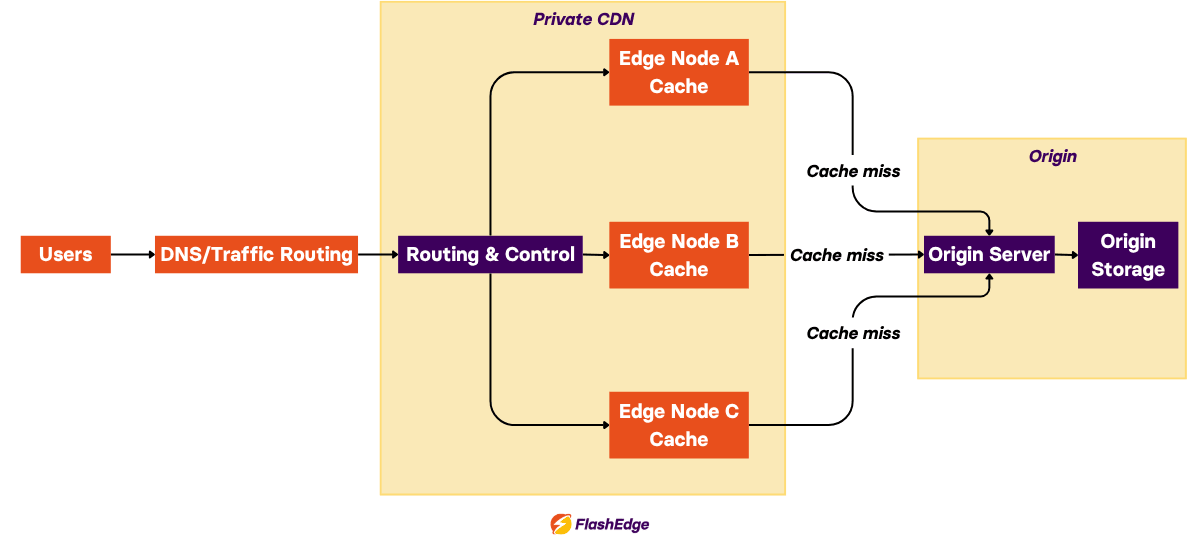
A private CDN typically consists of edge nodes placed close to your users, an origin (or several), and routing logic that decides which edge node serves each request. The network is dedicated, so your team has direct control of cache invalidation policies, TLS termination, load balancing rules and even the physical or virtual location of nodes.
Requests come in, get matched to the nearest or best-performing node, and are served from cache if the content is available there. If not, the edge node pulls from origin, caches the response according to your rules, and serves it forward.
Because the infrastructure is dedicated, organizations can also implement advanced optimizations such as custom cache key logic, origin shielding, proprietary request-routing algorithms and workload-specific traffic engineering that may not be available through managed public CDN services.
Key Characteristics
Dedicated hardware or reserved cloud capacity, not shared tenancy
Full administrative control over caching, routing and security policy, allowing organizations to define custom cache key behavior, deploy proprietary routing algorithms, implement bespoke security controls, or optimize delivery for highly specialized workloads that public CDNs may not support
Custom-built or heavily customized network topology
Typically requires an internal team with networking and systems expertise
Often chosen by organizations with strict data residency or compliance needs
What Is a Public CDN?
A public CDN is the model most people picture when they hear "CDN." Providers operate a large global network of edge servers and sell capacity on that shared network to thousands of customers.
You configure your caching rules through a dashboard or API, point your DNS at the provider, and your traffic rides on infrastructure that is also serving countless other websites and applications.
The provider handles hardware, network peering, capacity planning and most of the operational overhead.
In exchange, you give up some of the fine-grained control you would have with a private setup.
Although public CDNs operate shared infrastructure, modern providers use sophisticated resource isolation, traffic engineering, and capacity planning to minimize interference between customers. For most workloads, multi-tenancy has little impact on performance.
So what is a public CDN in practical terms? It is a managed, multi-tenant service that trades some customization for speed of deployment, global reach out of the box and a much smaller operational burden on your own team.
Private CDN vs Public CDN: What's the Difference?
The comparison below covers the areas that actually matter when you're deciding between a private CDN and a public CDN.
| Feature | Private CDN | Public CDN |
|---|---|---|
| Infrastructure | Dedicated to one organization, single-tenant | Shared across many customers, multi-tenant |
| Ownership | You own or directly control the edge nodes | Provider owns and operates everything, you rent capacity |
| Performance | Can be optimized for specific traffic patterns, cache hit ratios, routing policies and origin behavior | Strong by default, driven by scale and a large point-of-presence footprint |
| Scalability | Scales with provisioned capacity, needs planning and lead time | Scales almost instantly from a shared capacity pool |
| Customization | High, supports custom routing logic and caching rules | Limited to the provider's configuration options |
| Security | Full control over TLS, certificate management, access policies, data residency and compliance requirements | Built-in DDoS protection, WAF, bot mitigation and managed certificate lifecycle |
| Maintenance | Requires an internal team to patch, monitor and maintain | Maintained by the provider as part of the service |
| Global coverage | Requires significant investment to build out | Broad worldwide coverage out of the box |
| Cost | Higher upfront cost, can be cheaper at very high predictable volumes | Pay-as-you-go, costs scale directly with usage |
| Operational complexity | Adds real operational weight to your own team | Most of that complexity shifts onto the provider |
Running a private CDN involves much more than deploying edge servers. Teams are responsible for software updates, monitoring edge node health, capacity planning, routing changes, cache invalidation, incident response and ongoing infrastructure maintenance. A public CDN shifts most of these operational responsibilities to the provider.
Advantages and Disadvantages of a Private CDN
A private CDN is not automatically the better option just because it sounds more sophisticated. Here's a balanced view of where it helps and where it hurts.
| Advantages | Disadvantages |
|---|---|
| Full control over caching rules, routing and TLS configuration | Requires an internal team with real networking expertise |
| Better fit for strict data residency and compliance requirements | Slower to deploy than signing up for a managed service |
| Can be optimized precisely for your specific content and traffic patterns | Building global coverage is expensive and takes time |
| Greatly reduces the risk of noisy-neighbour effects because infrastructure is dedicated to a single organization | Ongoing maintenance and patching sit on your team |
| Potentially lower cost at very large, predictable scale | Harder to scale quickly during unexpected traffic surges |
When Should You Choose a Private CDN?
A private CDN tends to make sense when:
Your organization handles regulated data and needs direct control over where content is cached and how it's secured
You have predictable, very high traffic volumes where dedicated capacity becomes more cost-effective than pay-as-you-go pricing
Your delivery requirements are unusual enough that standard public CDN configuration options don't cover them
You already have, or are willing to build, an internal team with the networking expertise to run and maintain the network
You need behavior or protocol support that public CDN providers don't offer
When Is a Public CDN the Better Choice?
A public CDN is usually the better fit when:
You want to get global performance improvements live as quickly as possible
Your traffic is variable or unpredictable, and you'd rather not overprovision dedicated capacity
Your team is small, or your engineering time is better spent on your product than on network operations
You want built-in DDoS protection, WAF and bot mitigation without building it yourself
You're an early-stage company and capital efficiency matters more than architectural control
Can You Combine Private and Public CDNs?
Yes, and plenty of organizations do this. A hybrid approach might mean using a public CDN for general static content and global reach, while routing sensitive or high-value traffic through a private CDN with tighter controls. Others use a private CDN as the primary delivery layer and a public CDN as overflow capacity during traffic spikes (sometimes called cloud bursting). The two models aren't mutually exclusive, and a lot of the most resilient architectures use both for their respective strengths.
A common pattern is to use a public CDN for static assets such as images, JavaScript and CSS while reserving a private CDN for authenticated applications, APIs or workloads with strict compliance requirements. Larger organizations may also combine multiple public and private CDNs to improve resilience, steer traffic dynamically or reduce latency in specific regions.
How to Choose Between a Private and Public CDN
There's no universal answer here, but a few questions will get you most of the way to a decision:
Do you have compliance or data residency requirements that demand direct infrastructure control?
Is your traffic predictable enough to justify dedicated capacity, or does it spike unpredictably?
Does your team have the networking expertise to operate a private CDN, or would that time be better spent elsewhere?
How much does time-to-deploy matter for your current roadmap?
What does the cost look like at your actual traffic volume, not just today but in twelve to twenty-four months?
If you're still unsure, the reference table below could help to point you in the right direction.
| If your organization… | Consider |
|---|---|
| Needs the fastest deployment with minimal operational overhead | Public CDN |
| Has strict compliance or data residency requirements | Private CDN or hybrid |
| Serves predictable, high-volume traffic | Private CDN may become cost-effective |
| Experiences highly variable traffic | Public CDN |
| Requires both flexibility and infrastructure control | Hybrid development |
Most teams land somewhere in the middle. If you're reading this because your organization is scaling fast and running into latency, cost or compliance walls with your current setup, it's worth mapping your actual traffic and requirements against the table above before committing either way.
A conversation with a CDN provider that supports both public and private deployment models can also help you stress-test the decision before you build anything. If you're weighing up private, public or hybrid deployment models, talk to the FlashEdge engineering team. We'll help you evaluate the trade-offs based on your infrastructure, traffic patterns and business requirements.
Frequently Asked Questions
Is a private CDN more secure than a public CDN?
Not automatically. A private CDN gives you more direct control over security policy, which helps in regulated environments, but public CDN providers invest heavily in DDoS protection, WAF and bot mitigation at a scale most internal teams can't match. Security depends more on how well either option is configured and maintained than on which model you choose.
Is a private CDN more expensive than a public CDN?
It depends on your traffic volume. A private CDN usually involves higher upfront and ongoing engineering cost, but at very high and predictable traffic levels it can end up cheaper than pay-as-you-go public CDN pricing. At lower or variable traffic volumes, a public CDN is almost always more cost-effective.
Can a small company use a private CDN?
Technically yes, but it's rarely practical. Building and maintaining a private content delivery network requires networking expertise and ongoing operational investment that most small teams don't have spare capacity for. Most smaller organizations get better results from a public CDN, at least until traffic and requirements justify the switch.
What is a public CDN used for?
A public CDN is used to speed up content delivery, reduce origin load and improve reliability for websites and applications by caching content on a shared global network of edge servers operated by a third-party provider. It's the default choice for most organizations because it requires little setup and no infrastructure management.
Do private CDNs still use edge caching?
Yes. A private CDN uses the same core caching and edge delivery concepts as a public CDN. The difference is who owns and controls the infrastructure, not the underlying technology.
Is a private CDN always faster than a public CDN?
Not necessarily. A private CDN can be optimized for a specific workload, but performance depends on factors such as network design, edge locations, cache efficiency and operational expertise. Large public CDNs often have broader global coverage and extensive peering relationships, making them faster for many workloads.
Can I migrate from a public CDN to a private CDN later?
Yes. Many organizations start with a public CDN because it's quick to deploy and requires little operational overhead. As traffic grows or compliance requirements become more demanding, they gradually migrate selected workloads to a private CDN or adopt a hybrid architecture.