

Network performance optimization covers anything you do to improve the speed, reliability, and efficiency of data delivery across your infrastructure.
Optimized network performance is crucial to get the most out of your network; after all, a solid network is the basis for high-performing applications. Without optimizing your network, you'll experience low response times, latency spikes, and inconsistent application performance, all of which directly affect user experience, reduce productivity, and increase infrastructure costs.
This guide explains what causes performance problems, how to measure them correctly, and which network optimization techniques consistently deliver the biggest improvements. Learn how to systematically improve network performance by identifying bottlenecks, measuring the right metrics, and applying the highest-impact optimization techniques.
Read on for more actionable ways to improve network performance, and a much better idea of what could be causing problems.
Quick Summary
Network performance optimization focuses on reducing latency, increasing efficiency, and improving reliability.
The most effective optimization initiatives start with measurement and identifying bottlenecks.
Routing improvements, caching strategies, and CDN deployment often produce the largest gains.
Network optimization is an ongoing process that requires continuous monitoring and adjustment.
Why better network performance leads to faster, more reliable user experiences
Pretty much every application depends on network performance, from APIs, SaaS platforms, websites, or streaming services. Even relatively small increases in latency can have a noticeable real-world impact on your engagement and conversion rates; as responsiveness drops, so does user satisfaction.
Performance issues usually develop gradually; a network can perform adequately one day, then on another day with higher traffic problems can appear. This can be down to many things such as inefficient routing, poor caching policies, or overloaded infrastructure, which can make it more difficult to diagnose the core issue.
This is why network performance optimization should be treated as a continuous engineering discipline rather than a one-time project. The most successful teams consistently measure performance, implement improvements, validate results, and repeat the process as requirements evolve and applications grow more complex.
What is network performance optimization?
Network performance optimization is the practice of improving how efficiently data moves between systems and users.
There are many things organizations stand to gain from optimizing their networks, for example:
Lower latency
Higher throughput
Better reliability
Reduced congestion
Improved scalability
Lower infrastructure costs
Optimization is not just about adding more bandwidth; in many environments, latency, inefficient routing, and poor cache utilization create much larger performance limitations than capacity constraints. Networks need to be organized efficiently to provide the best possible performance.
What's slowing down your network performance?
Most environments which experience poor network performance have multiple contributing factors working at once to cause issues.
The most common causes include:
Network bottlenecks
High latency
Packet loss and retransmissions
Inefficient routing paths
DNS resolution delays
Poor cache utilization
Uneven traffic distribution
Legacy infrastructure limitations
Insufficient monitoring visibility
These problems often pile on top of each other to compound the issue: poor caching increases origin load, routing inefficiencies increase latency, and congested infrastructure introduces packet loss and retransmissions.
To properly diagnose performance problems you'll need to measure and analyze key metrics with network performance monitoring; making assumptions won't work.
Measure now, save time later
Many optimization projects fail because teams make changes before they fully understand the issue. Increasing bandwidth is a waste of time and resources when latency is the real issue, and the same goes for upgrading infrastructure when poor caching is leading to unnecessary origin requests.
Successful network performance improvement always starts with establishing a baseline. Track metrics such as:
Latency
Throughput
Packet loss
Cache hit ratio
Error rates
Infrastructure utilization
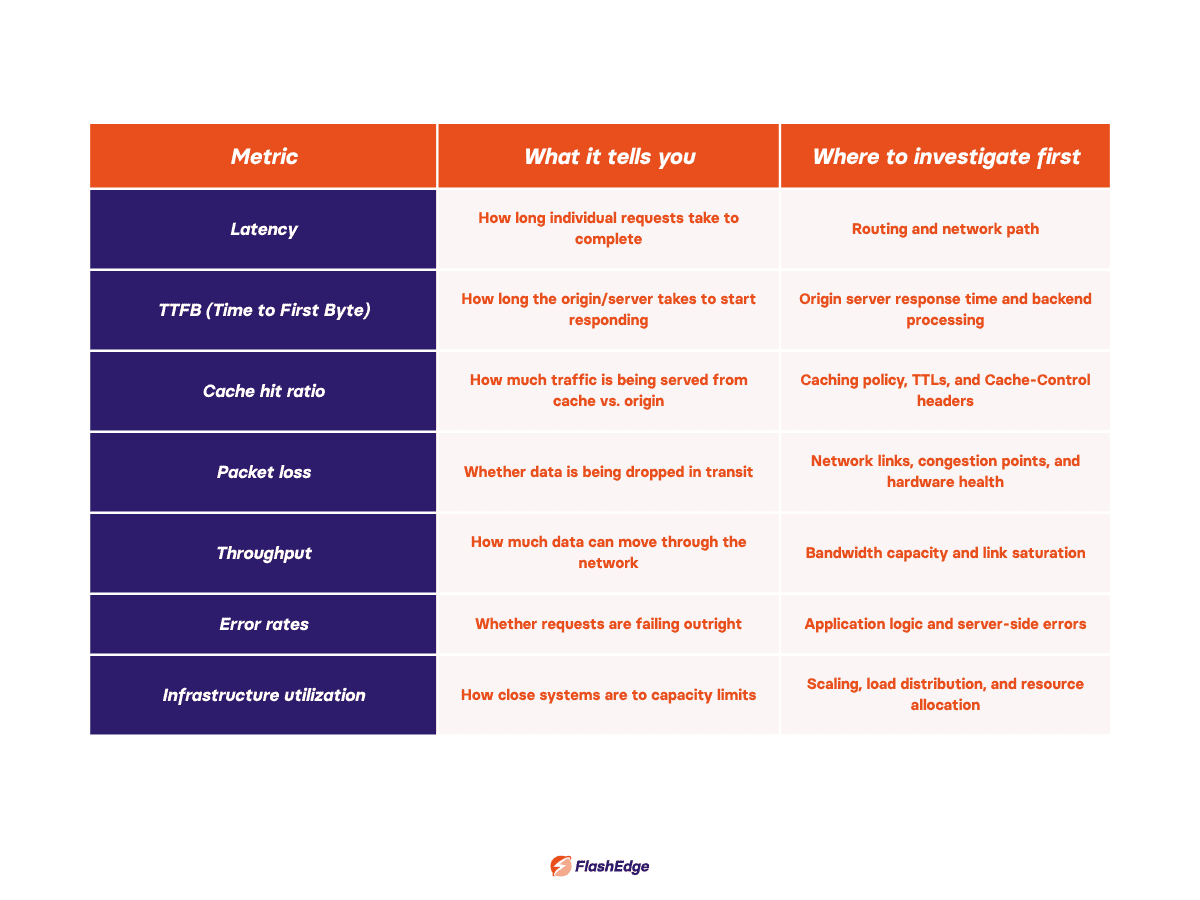
Sustained packet loss above 1% can noticeably degrade many applications, while real-time services such as VoIP and video may be affected by even lower levels of loss.
Measure performance during both normal and peak traffic periods and across multiple geographic regions. A network that performs well under average conditions may behave very differently during product launches or unexpected traffic spikes.
Continuous network performance monitoring provides the visibility needed to prioritize improvements and verify results.
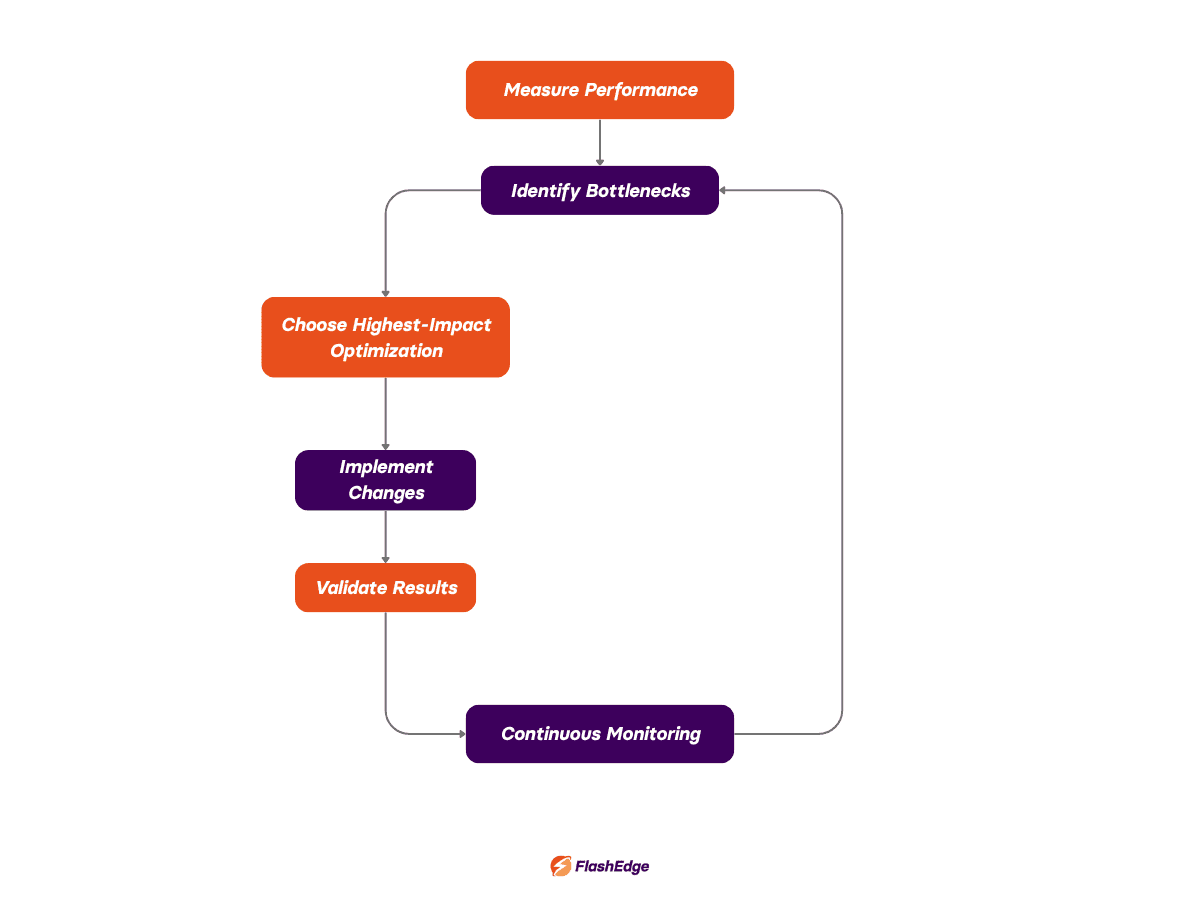
Network performance optimization, step-by-step
Step 1: Measure the right metrics. Measure latency, Time to First Byte (TTFB), cache hit ratio, packet loss, and other key performance indicators. This will help you to establish a baseline.
Step 2: Identify the biggest bottleneck. Analyze the results to figure out which issue has the biggest impact (for example: latency, inefficient routing, poor cache utilization, overloaded infrastructure, or another constraint).
Step 3: Prioritize the highest-impact optimization. Focus on the change most likely to improve performance; this is cleaner than applying multiple optimizations simultaneously.
Step 4: Validate every change. After each optimization, measure performance again to confirm that it produced the expected improvement and didn't introduce any further issues.
Step 5: Continue monitoring. Applications evolve and traffic patterns shift, so it's important to keep monitoring to ensure you detect issues early.
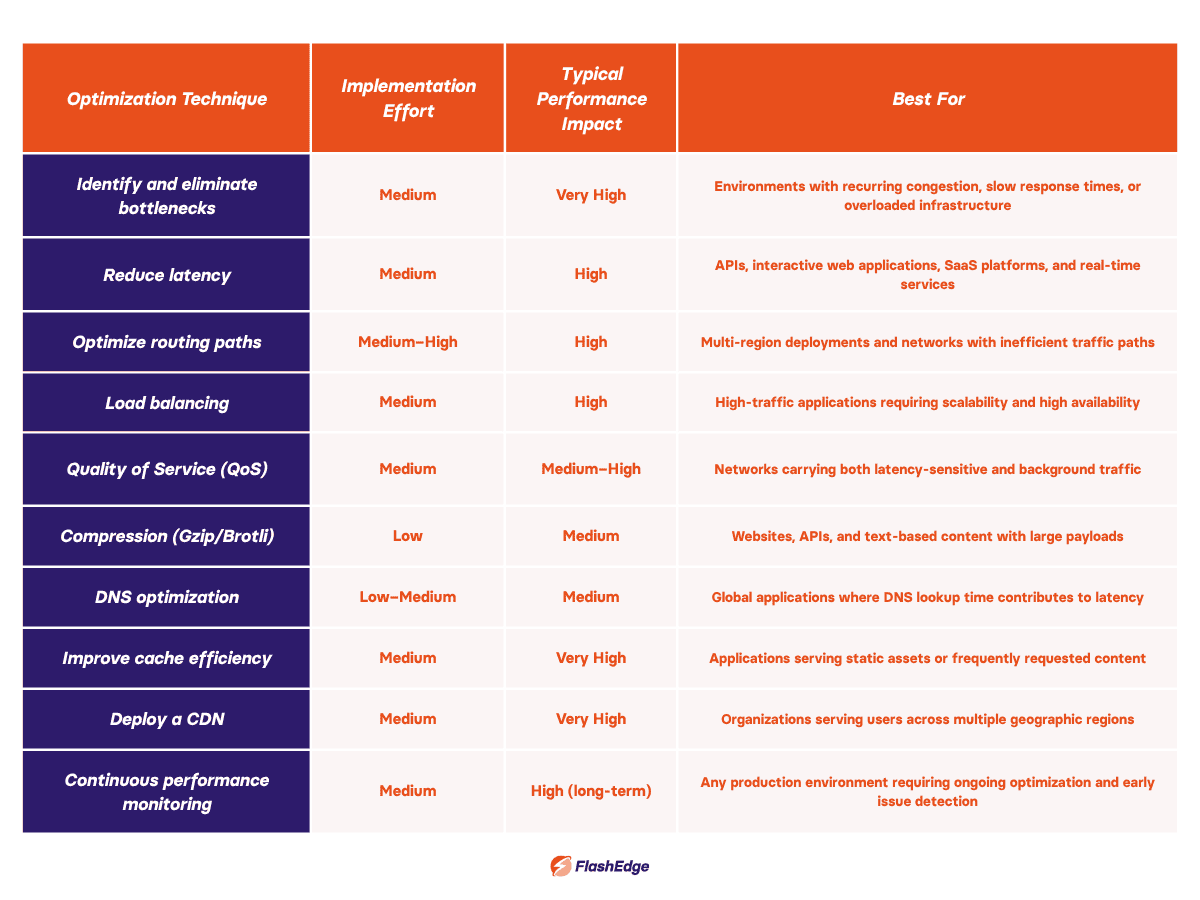
10 network optimization techniques that deliver the biggest performance improvements
1. Identify and eliminate network bottlenecks
A bottleneck is any point where traffic demand exceeds available capacity. This could be a saturated uplink, overloaded router, constrained database connection pool, or an application server struggling to keep pace with concurrent requests.
Bottlenecks are particularly harmful because delays propagate throughout the delivery chain. Users experience slow responses or timeouts even when most of the infrastructure still has spare capacity, and as a result, eliminating a single bottleneck can significantly improve performance across an entire environment.
It's much easier to locate the source of network congestion when you have in-depth visibility from monitoring. Make sure you're monitoring utilization across network, application, and infrastructure layers at the same time.
For a more in-depth understanding of bottlenecks, read FlashEdge's blog post on how to identify and resolve bottlenecks.
2. Reduce latency wherever possible
Network latency affects every request-response cycle, causing delays, reduced throughput, and a poor user experience overall. Delays can be influenced by many factors such as long distances, multiple network hops, inefficient routing, and excessive origin requests, but there are practical ways for you to reduce it:
Enable HTTP/2 or HTTP/3 to multiplex requests efficiently
Use persistent Keep-Alive connections
Reduce unnecessary redirects
Consolidate excessive API requests
Remove redundant third-party dependencies
Deliver content closer to users
Reducing latency by even 50 to 100 milliseconds can noticeably improve application responsiveness, especially for interactive applications and APIs.
3. Optimize routing paths
Routing refers to choosing the path for traffic in a network. If traffic is organized suboptimally, it can lead to unnecessary delays and inconsistent experiences across geographical regions.
If you apply routing policies to optimize the path your traffic takes, you can reduce bottlenecks and latency and increase bandwidth. It can also help to prevent service outages in the case of unexpected traffic spikes.
Routing isn't a one-time task, it requires continued monitoring. If routing is causing issues in your network, you can substantially improve response times by regularly reviewing routing behavior, analyzing network paths, and implementing intelligent traffic engineering.
Redundant paths, which work like backup paths in case your main route fails or is overloaded, also improve resilience by automatically redirecting traffic when individual routes degrade.
4. Implement load balancing
Load balancing distributes traffic in the most efficient way possible across your infrastructure, preventing individual systems from becoming overloaded.
Benefits include:
Better resource utilization
Improved availability
Lower response times
Higher scalability
Modern load balancers can distribute requests using application-aware rules, geographic information, or backend health status.
It's common to configure health checks every 5 to 30 seconds so that unhealthy resources can be automatically removed from rotation before failures cascade into larger outages.
5. Prioritize critical traffic with quality of service
Different workloads come with different service requirements. Video conferencing, payment processing, and transactional APIs often need low-latency delivery, but backups and bulk data transfers can tolerate delays.
Quality of Service policies prioritize important traffic and prevent lower-priority workloads from affecting user experience. Practical QoS implementations commonly use traffic classification and DSCP markings to identify workloads and assign different service priorities.
Environments which carry a mix of real-time and background traffic especially feel the benefit of QoS.
6. Use compression to reduce payload size
Large payloads take much longer to transfer and consume additional bandwidth, but you can prevent this issue by enabling compression. Compression reduces the amount of data that needs to traverse the network; commonly used technologies for compression are Brotli and Gzip.
HTML, CSS, JavaScript, and JSON responses frequently shrink by 60% to 80% compared with uncompressed delivery.
Compression is particularly effective for:
APIs
Configuration files
Static assets
Log transfers
Note: Already compressed formats such as JPEG, MP4, and ZIP files should generally be excluded because recompression provides minimal benefit while consuming CPU resources.
7. Optimize DNS Resolution
DNS resolution occurs before any application content can be delivered, so even small DNS delays affect every subsequent interaction.
Practical optimizations include:
Using globally distributed Anycast DNS providers
Reducing unnecessary lookups
Minimizing long CNAME chains
Enabling DNS caching
Using DNS prefetching where appropriate
Dynamic DNS records typically benefit from shorter TTL values, commonly between 300 and 900 seconds, to allow faster propagation when changes occur.
Longer values reduce lookup frequency but increase propagation times when changes occur.
Although individual lookups may only add tens of milliseconds, these delays quickly accumulate across large applications and geographically distributed user bases.
8. Improve cache efficiency
Caching is one of the most effective (and well-known) methods for both reducing latency and minimizing origin load.
Improving cache hit ratio is often one of the fastest ways to optimize network performance. A cache hit ratio above 80% generally indicates good efficiency, and highly cacheable environments frequently exceed 95%. Even a 10% to 20% increase in cache hit ratio can dramatically reduce origin requests and infrastructure costs.
Practical ways to improve cache efficiency include:
Using appropriate Cache-Control headers
Applying different caching policies to static and dynamic content
Avoiding unnecessary query parameters
Implementing stale-while-revalidate
Reviewing assets with unexpectedly low cache hit ratios
For versioned static assets, a common best practice is setting TTL values of up to one year because version hashes automatically invalidate outdated files.
9. Accelerate content delivery with a CDN
For organizations serving users across multiple regions, deploying a CDN is often one of the highest-impact network optimization strategies.
A CDN distributes content across globally dispersed edge locations positioned close to users. Instead of every request travelling back to a centralized origin server, requests can frequently be served directly from nearby edge infrastructure.
The benefits include:
Reduced origin load
Better scalability
More consistent global performance
Improved resilience during traffic spikes
Organizations with effective edge caching strategies frequently reduce origin bandwidth consumption by 50% to 90%.
Users located far from origin infrastructure can also experience latency reductions measured in hundreds of milliseconds.
A CDN often delivers improvements that cannot be achieved through bandwidth upgrades alone. If you're evaluating CDN platforms, FlashEdge is happy to help. Our engineers can give you advice tailored to your infrastructure, or you can try a free trial to see exactly how FlashEdge could help your organization improve performance while reducing origin load and infrastructure costs.
10. Continuously monitor performance
Optimization is never finished, and to ensure your network is always performing as well as possible it's important to be consistent with network performance tuning.
Applications evolve, traffic patterns shift, and infrastructure requirements constantly change, but with continuous monitoring teams are able to:
Detect degradation early
Validate optimization efforts
Identify emerging bottlenecks
Understand changing traffic patterns
Prevent performance regressions
Synthetic monitoring that simulates user activity from multiple regions is particularly useful because it helps to identify issues before real users are affected. On the flipside, performance that isn't actively monitored eventually degrades as applications and infrastructure evolve.
Common network performance optimization mistakes
Some mistakes are frequently repeated by teams when confronted with network performance issues, for example:
Optimizing before measuring: Making changes without baseline metrics often results in wasted effort and inconclusive outcomes.
Chasing bandwidth instead of latency: Bandwidth and latency are different problems. Increasing capacity rarely fixes delays caused by geographic distance, routing inefficiencies, or excessive round trips.
Ignoring cache efficiency: Poor caching strategies force origin servers to handle requests that should never have reached them.
Neglecting monitoring: Performance improvements that are not monitored frequently regress over time.
Focusing only on infrastructure: Infrastructure matters, but routing, caching, and content delivery architecture often influence performance just as much as servers and bandwidth.
How CDNs improve network performance
CDNs directly address several common causes of poor performance simultaneously.
Edge locations reduce physical distance between users and content. Caching minimizes origin requests and lowers infrastructure demand. Distributed capacity absorbs traffic spikes and improves scalability. Private backbone networks can bypass congested public internet routes and provide more predictable performance.
These capabilities become increasingly valuable as applications scale globally. Performance problems that might initially be solved with additional infrastructure often become significantly more difficult and expensive to address over time.
A modern CDN platform simplifies many of these challenges by combining global edge delivery, intelligent caching, origin offload, and optimized routing within a single platform. For teams looking to increase network performance without overhauling existing infrastructure, the right CDN can address the most costly issues (latency, origin overload, and inconsistent global delivery) in a single deployment. FlashEdge is designed specifically to help teams reduce latency, improve cache efficiency, and deliver reliable application performance at scale. Start your free FlashEdge trial today or speak with a FlashEdge consultant to discover which optimizations will have the greatest impact on your architecture.
Conclusion
Network performance optimization is an ongoing discipline rather than a one-time initiative.
The most successful teams measure first, identify bottlenecks, and focus on the optimization techniques that deliver the highest impact for their environment.
Bottleneck elimination, latency reduction, routing optimization, caching improvements, load balancing, compression, and CDN deployment consistently improve speed, reliability, and scalability.
Teams that make network optimization part of their regular engineering process are far better positioned to deliver fast, reliable digital experiences as applications, traffic, and user expectations continue to grow.
Frequently Asked Questions
What is network performance optimization and why is it important?
Network performance optimization is the process of improving the speed, reliability, and efficiency of network communications. It involves identifying issues such as latency, bottlenecks, inefficient routing, and poor caching, then applying targeted improvements. It is important because network performance directly influences application responsiveness, user satisfaction, and infrastructure costs.
Which network optimization techniques usually deliver the biggest improvements?
The techniques that consistently produce the largest gains include eliminating bottlenecks, reducing latency, improving cache efficiency, optimizing routing paths, implementing load balancing, and deploying a CDN. The most effective combination depends on your applications, traffic patterns, and user locations, so monitoring those metrics is crucial to correctly identify which optimization techniques you should use.
Why is latency often more important than bandwidth?
Bandwidth determines how much data can be transferred, while latency determines how long individual requests take to complete. Most modern applications depend on numerous sequential requests, meaning high latency can make applications feel slow even when bandwidth is plentiful.
How does a CDN improve network performance?
A CDN improves network performance by placing content on edge servers located close to users. This reduces round-trip times, decreases origin load, lowers bandwidth consumption, and provides more consistent performance across geographic regions. Many organizations also use CDNs to improve scalability and absorb traffic spikes more efficiently.
How often should network performance be monitored?
Network performance monitoring should be continuous. Real-time monitoring allows teams to detect degradation quickly, validate optimization initiatives, and identify emerging issues before they affect users. Regular performance reviews are also useful for identifying gradual changes that may not trigger alerts but still indicate declining efficiency.