

Choosing the best video CDN for you depends on your priorities and preferences. Cost, integration effort, and CDN performance are all factors to consider—whether you're looking for the best CDN for video streaming, a cheap option for an early-stage product, or an enterprise-grade solution. Read on for a real-world comparison that takes various use cases into account.
In this guide, we’ll compare leading video CDN providers for both live streaming and video on demand (VOD), explain what actually matters when evaluating them, and help you choose a solution that aligns with your specific use case rather than just a feature list.
Quick Summary
- A video CDN improves delivery by caching content closer to users
- The best video CDN for you depends on latency, scale, and cost priorities
- Live streaming and VOD require different optimization strategies
- There are both enterprise platforms and a cheap CDN for video streaming that can work well
- Real-world performance often differs from vendor claims
What is a video CDN?
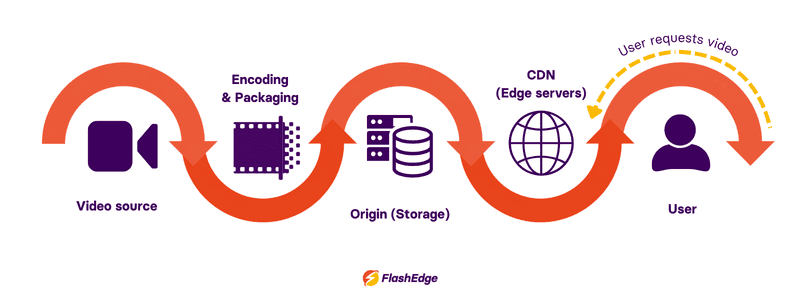
A video CDN—sometimes called a content delivery network for video streaming—is a distributed network that caches and delivers video content from locations closer to the end user. Instead of relying on a single origin server, requests are handled by edge nodes, reducing latency and improving throughput.
Why CDNs matter for video delivery
Video is one of the most demanding content types to deliver. Unlike static assets, it requires sustained bandwidth over time, and any interruption becomes immediately visible to the user—a small delay that might go unnoticed on a webpage can result in buffering during playback. Reducing physical distance between content and user with a CDN improves both startup time and stability.
Benefits of using a CDN for video
- Faster playback startup
- Reduced buffering
- More consistent cross-region performance
- Better handling of traffic spikes
- Lower origin load
FlashEdge offers a Video CDN—you can learn about its features and how it works on the FlashEdge video CDN page.
Key features to consider in a video CDN
To evaluate the best video CDN, you can start by looking at how features behave under real conditions.
Performance and latency
Network latency is one of the most visible aspects of streaming performance: for VOD, it mostly affects how quickly a video starts, while for live streaming it directly impacts how “real-time” the experience feels.
The best CDN for live streaming typically focuses on minimizing latency without sacrificing stability. In practice, that means optimizing routing, edge caching behavior, and streaming protocols. However, extremely low latency setups can increase complexity and cost. The right balance for this trade-off should be evaluated on a case-by-case basis.
Scalability and traffic handling
Video traffic rarely scales in a predictable way. A platform might operate at a steady baseline for weeks and then suddenly experience a sharp spike due to an event, campaign, or viral content.
The best CDN live streaming platforms handle these spikes with no need for manual scaling or intervention. From a user perspective, nothing should change—no buffering, no degradation in quality. From an engineering perspective, this is where the maturity of a CDN becomes visible. Some providers handle burst traffic gracefully, while others struggle under sustained load.
Pricing and cost structure
It’s easy to underestimate the pricing of a video CDN during initial evaluations, as many providers have similar pricing at low usage levels. However as traffic increases, pricing can significantly diverge.
A cheap CDN for video streaming can be a good starting point, especially for smaller platforms or early-stage products. However, it’s important to understand how pricing evolves:
- Does cost increase linearly with bandwidth?
- Are there regional price differences?
- Are there hidden fees for requests or cache misses?
Unexpected cost spikes are one of the most common complaints teams have after choosing a CDN.
💡Tip: For a detailed cost comparison of different CDNs, see our article CDN Pricing Comparison: Evaluating the Cheapest CDN Services.
Protocol support and streaming formats
Most CDNs support standard protocols like HLS and MPEG-DASH. These are widely used for both live and on-demand video.
For more advanced use cases, low-latency streaming options are becoming increasingly important. Not every provider supports these equally well, and implementation details can vary. If your product roadmap includes interactive or near-real-time features, this is worth evaluating early to prevent future limitations.
Security
As video platforms grow, security becomes more relevant (for example, for paid content, licensed media, or region-restricted distribution). Common security features include:
- Token-based authentication
- Signed URLs
- DRM
- Geo restrictions
While security support exists across most video CDN providers, implementation quality differs.
Analytics and monitoring
Streaming issues are rarely immediately obvious from the backend alone. A video might play perfectly in one region and struggle in another.
Detailed analytics help answer questions like:
- Where are users experiencing buffering?
- Is performance consistent across regions?
- Are issues related to encoding or delivery?
Without this visibility it can be difficult to identify and resolve streaming issues.
Flexibility across live and VOD workflows
Some CDNs are historically stronger at handling live streaming, while others focus more on VOD. Increasingly, teams want a single solution that handles both.
This reduces operational complexity while preventing limitations in your future operations. When you evaluate the best CDN for video hosting, it’s important to consider how the provider handles both scenarios.
Why context matters when choosing a CDN
It's tempting to look for a definitive answer to questions like:
- What's the best CDN for high quality video streaming?
- Who are the top live streaming CDN providers?
- What's the best CDN for live streaming or video hosting?
In practice, the answer depends on a few variables, for example:
- Traffic patterns
- Geographic distribution
- Latency requirements
- Budget constraints
- Internal engineering resources
A platform focused on live sports streaming will prioritize different features than a SaaS product embedding tutorial videos. Similarly, a global media company will evaluate CDNs differently than a startup managing cost carefully.
In the next section, we’ll look at the leading video CDN providers, compare their strengths and limitations, and map them to typical use cases like live streaming, VOD, SaaS delivery, and high-traffic distribution.
Best Video CDN Providers in 2026
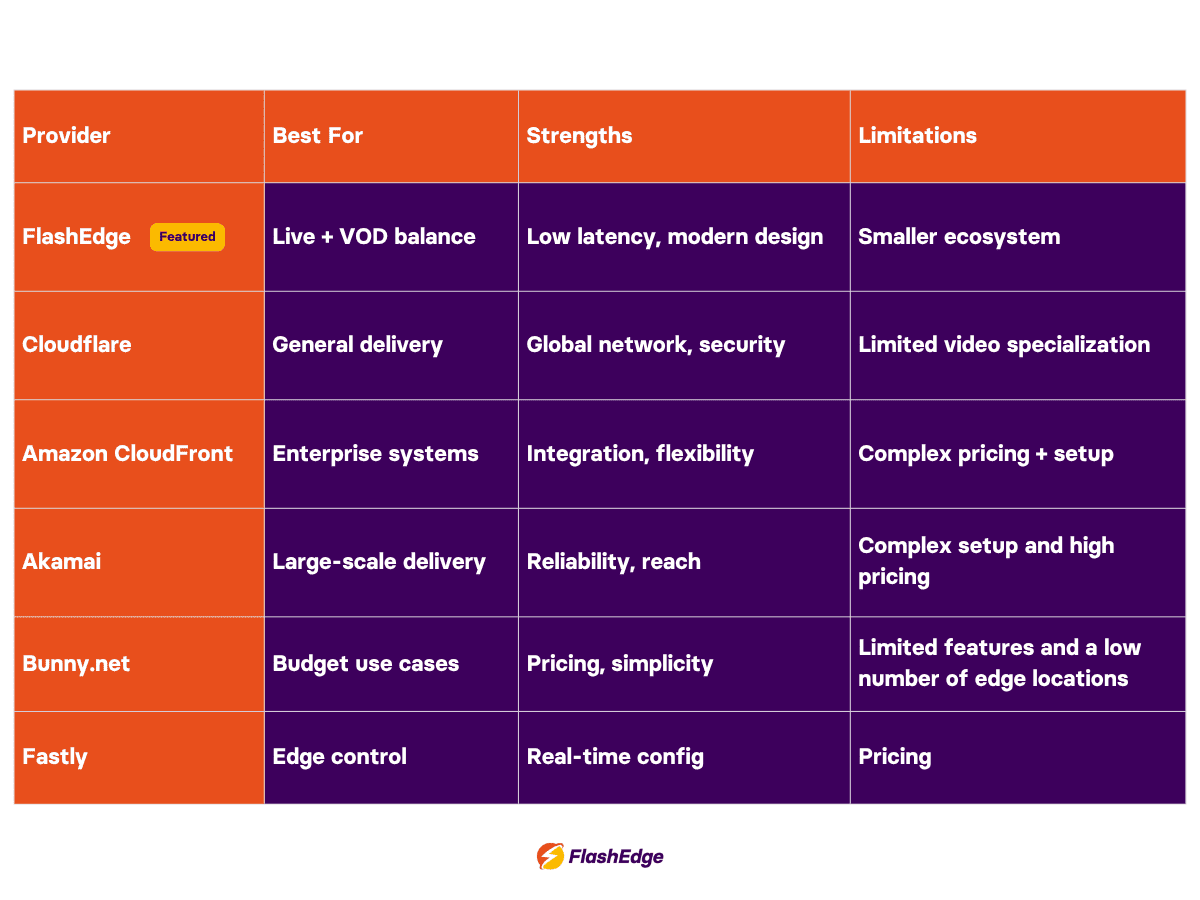
Comparison Table
In-depth reviews of leading video CDN providers
Providers often differ in the following areas:
- Latency consistency (not just averages)
- Cost scaling behavior
- Operational complexity
- Level of control vs simplicity
Below, we go into a little more depth about each video CDN provider we compared in the above table.
FlashEdge
FlashEdge positions itself around a fairly clear idea: streaming today should be low-latency by default and shouldn’t require a complicated setup to get there.
Strengths:
- Consistent low-latency delivery for both live and VOD
- Designed with modern streaming patterns in mind
- Integration is more straightforward compared to legacy providers
Limitations:
- Smaller ecosystem compared to long-established providers
- Fewer third-party integrations (though this is improving)
Use Cases:
- SaaS platforms with embedded video
- Growing streaming platforms
- Projects where both live and VOD matter
FlashEdge appeals to teams that want solid performance without building a lot of infrastructure around it.
Cloudflare
Cloudflare is often one of the first providers teams consider, mainly because of its scale and brand recognition.
Strengths:
- Very large global network
- Built-in security features (DDoS protection, WAF, etc.)
- Easy to adopt for teams already using Cloudflare
Limitations:
- Not always the best CDN for video hosting when advanced streaming features are required
- Less specialized tooling for complex video workflows
Use Cases:
- Websites with embedded video
- Platforms where video is not the primary product
- Teams prioritizing simplicity over deep customization
Cloudflare works well as a general-purpose CDN, but it may not be the strongest option for more demanding streaming setups.
Amazon CloudFront
CloudFront is a common choice in enterprise environments, especially when teams are already using AWS services.
Strengths:
- Deep integration with the AWS ecosystem
- High level of configurability
- Scales reliably at large volumes
Limitations:
- Pricing is often difficult to predict
- Setup and ongoing management require experience
- Debugging issues can be more involved
Use Cases:
- Large-scale systems built on AWS
- Platforms requiring custom infrastructure control
CloudFront can be powerful, but it tends to work best when there’s already a team comfortable managing AWS infrastructure.
Akamai
Akamai has been a major player in content delivery for a long time and remains one of the most recognized video CDN providers.
Strengths:
- Extensive global infrastructure
- Strong track record for reliability
- Handles large-scale traffic without issue
Limitations:
- Premium pricing
- Less flexible for smaller teams or fast iteration
Use Cases:
- Global broadcasters
- Media companies with large audiences
- High-stakes streaming environments
Akamai is often chosen when reliability is the top priority and cost is less of a constraint.
Bunny.net
Bunny.net has built a reputation as a cheap CDN for video streaming that still delivers solid performance.
Strengths:
- Transparent and competitive pricing
- Quick and simple setup
- Good performance for the cost
Limitations:
- Limited advanced features
- Smaller network compared to larger providers
Use Cases:
- Startups and early-stage products
- Cost-sensitive platforms
- Smaller-scale video delivery
Bunny.net is often a practical starting point, especially when budget matters more than advanced functionality.
Fastly
Fastly focuses heavily on edge computing and real-time configuration.
Strengths:
- Fine-grained control over caching and delivery
- Strong performance for dynamic content
- Real-time configuration updates
Limitations:
- Pricing can increase quickly with usage
- More complexity compared to simpler CDNs
Use Cases:
- Interactive streaming platforms
- Applications requiring dynamic content delivery
- Teams needing tight control over behavior at the edge
Fastly tends to be chosen when flexibility and control are more important than simplicity.
Choosing the right CDN
Comparing providers is a useful starting point, but the right choice ultimately depends on your specific traffic patterns, latency requirements, and operational constraints. The following steps help you work through that evaluation systematically.
Step 1: Define your primary workload
Start by identifying what typically dominates your traffic. If it is:
- Live streaming, prioritize latency-sensitive, real-time delivery.
- VOD, prioritize cache efficiency, cost predictability.
- Mixed workloads, prioritize balanced optimization across both.
This helps you to determine whether you prioritize latency behavior or caching efficiency first.
Step 2: Set your acceptable latency range
Before you decide on a provider, you should decide what latency is “good enough” for you. If your expectations are:
- Sub-second then you should aim for strict, low-latency architectures.
- A few seconds then you can opt for simpler and cheaper delivery options.
This single core decision eliminates a large portion of mismatched providers.
Step 3: Map traffic reality, not averages
While traffic spikes may be outliers, it’s important that your video CDN provider can handle your peak traffic times. It’s important to consider:
- Peak traffic vs baseline
- Geographic concentration
- Burst frequency (for example how frequently do you have events, releases, viral spikes)
A CDN that performs well on average but degrades under spikes is usually a poor fit for production workloads.
Step 4: Validate cost behavior at scale
There are many factors that impact cost. Don’t stop at comparing entry pricing, instead you should simulate:
- Peak bandwidth usage
- Cross-region delivery
- Cache miss scenarios
By looking into these scenarios, you can see how predictable your costs remain when usage grows or varies.
Step 5: Test with real video traffic
Once you’ve evaluated the above factors, you can run a small production-like test with the CDNs on your shortlist. This will likely be much more revealing than any comparison table or article.
Run a small production-like test with:
- Same encoding pipeline
- Same player setup
- Real user geography (if possible)
Measure:
- Startup time
- Buffering ratio
- Latency stability under load
Step 6: Choose based on operational fit
At this point, the decision is usually less about raw capability and more about how quickly you can deploy changes, how much tuning is required to maintain performance, and how stable the system behaves under real-world traffic
In practice, teams tend to converge on platforms that require fewer adjustments once configured and behave consistently under load.
Next steps: Experience our video CDN solution
FlashEdge is designed for teams that want predictable video delivery without having to over-engineer the streaming stack.
At a technical level, the focus is on:
- Consistent low-latency behavior for live streams
- Efficient caching for VOD workloads
- Straightforward integration with existing players and pipelines
- Stable performance under burst traffic conditions
FlashEdge sets itself apart when you consider operational overhead. Instead of requiring continuous tuning across regions or traffic patterns, the system is built to behave consistently once configured, even when workloads shift between live and on-demand usage. This helps to keep your operations future-proof; a system that behaves predictably under load is typically easier to scale and maintain over time.
FlashEdge prioritizes stability and integration simplicity, while still supporting both live streaming and VOD delivery in a single setup. For many teams, that consolidation removes the need to maintain separate delivery paths or optimize two different systems in parallel.
A practical way to evaluate it is to run a small workload test using real traffic patterns: you can try FlashEdge today for free to see how it fits your organization.
FAQ
What is the best CDN for video streaming?
Depends on latency, cost, and integration requirements.
How does a CDN improve streaming quality?
By reducing distance between content and user, lowering buffering.
Can one CDN handle live and VOD?
Yes, most modern live streaming CDN providers support both.
What should I evaluate?
Latency, scalability, pricing, and regional performance.
Additional Resources
https://en.wikipedia.org/wiki/Content_delivery_network
https://aws.amazon.com/cloudfront/