

A high traffic website sounds like a good thing, bringing engagement and revenue to your company. Unfortunately without the right setup, high website traffic can expose vulnerabilities–pages lag, checkouts fail, and your website doesn’t follow through on its promises. In this guide we will explain exactly what happens when traffic spikes, why even well-established and high traffic sites can fail under pressure, and what you can do to ensure your website stays fast, stable, and profitable.
Quick Summary
- A high traffic website can slow down or crash if infrastructure isn’t prepared
- High user traffic often leads to failed checkouts, long load times, and downtime
- Most issues come from missing CDN, poor caching, or limited scalability
- Caching, CDN, traffic distribution, and monitoring solve the majority of problems
High traffic on websites: What really happens behind the scenes
Heavy traffic website load: When systems start to struggle
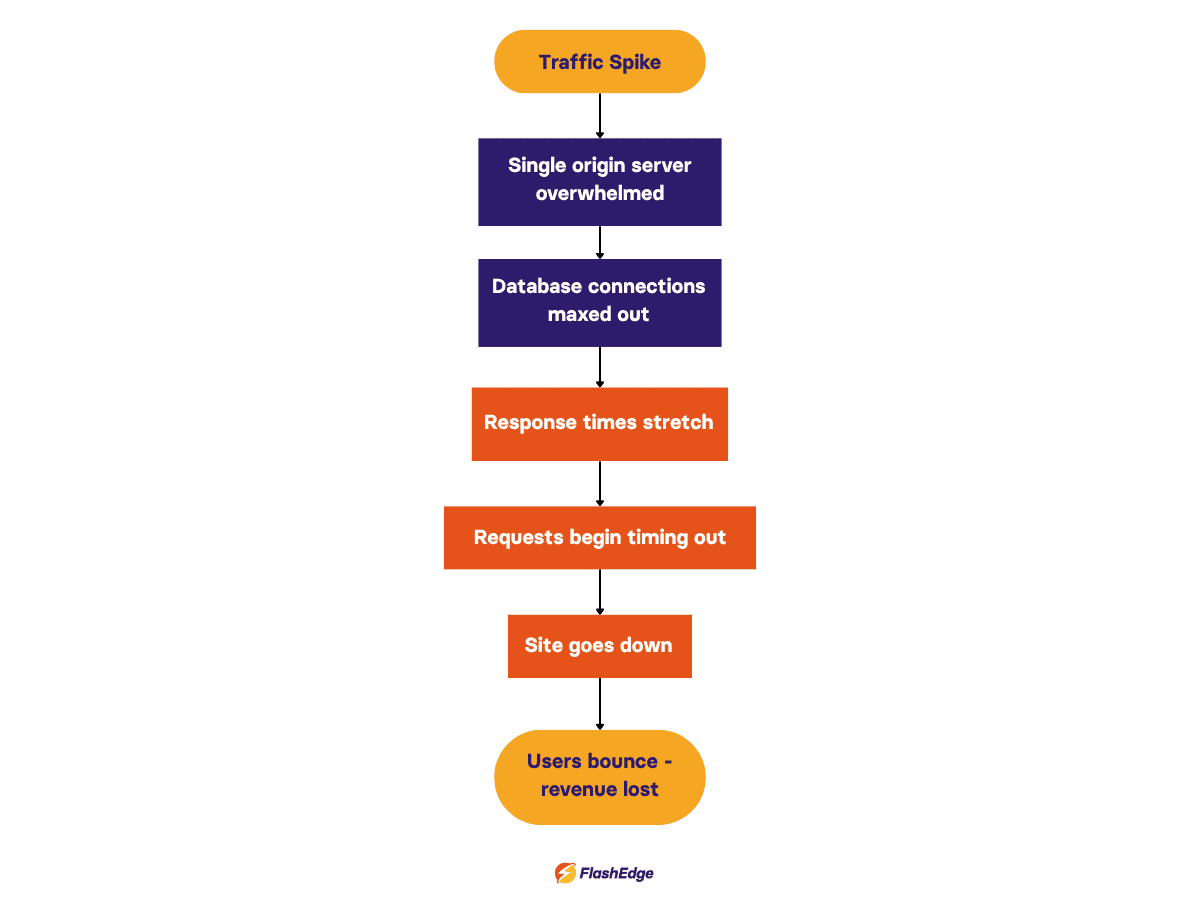
When a heavy traffic website gets a spike, the increase is sudden and intense. Thousands of users arrive at once, each triggering database queries, API calls, and backend processing.
If the system isn’t built for that level of concurrency, things start to queue up; database connections max out, response times stretch, and small delays compound quickly. High traffic blog sites are especially vulnerable here, because they often rely on dynamic content generation without enough optimization behind it.
High traffic sites: What users notice first
Users don’t care why something is slow—they just leave. Typical symptoms show up fast:
- Pages take too long → users bounce
- Checkout breaks → sales are lost in seconds
- Content loads unevenly → experience feels unreliable and users lose trust
- Site goes offline → users don’t come back
Too much traffic on website environments has a direct cost. Every second of delay or failure chips away at conversions and trust.
High user traffic: Why websites break under pressure
High traffic sites without CDN hit a wall
Serving everything from a single origin server works until traffic starts coming from different regions at scale. Requests have to travel longer distances which increases load times, and the origin server becomes a bottleneck under pressure. A CDN helps by delivering content from servers closer to users and taking a large share of the traffic off your main infrastructure. For a deeper dive into how CDN delivery works behind the scenes, check out FlashEdge’s detailed exploration of how CDNs actually work.
High traffic blog sites and weak caching
Without effective caching, every user request goes through the entire system—from the web server to the application and database. While that’s manageable at low traffic, under high traffic it causes the same data to be processed over and over again, putting unnecessary strain on the backend. Well-configured caching stores and reuses this data, reducing load and speeding up responses. For a more technical explanation of caching behavior and optimization strategies, see FlashEdge’s blog on CDN caching.
High traffic on website infrastructure that doesn’t scale
Many websites are built for typical traffic levels, not sudden spikes. When demand increases quickly, resources like database connections or server capacity get used up fast. Autoscaling can help, but it often takes time to respond. Without systems designed to scale horizontally, performance drops as soon as limits are reached.
High traffic sites without monitoring react too late
If you’re not tracking performance metrics like response times, error rates, and server load, problems go unnoticed until users are already affected. By that point, systems are often already overloaded and harder to stabilize. Monitoring tools provide early warning signs, so issues can be addressed before they impact users.
High traffic website fixes: How to keep performance stable
Optimization starts with caching
Caching reduces how often your backend has to do real work. Frequently requested content is served faster, and servers stay responsive even during spikes.
High traffic sites benefit from CDN distribution
A CDN delivers content from locations closer to users and absorbs traffic surges before they reach your core infrastructure.
Too much traffic on your website? Spread the load!
Load balancing distributes incoming traffic across multiple servers. Instead of one system struggling, the workload is shared, keeping performance consistent.
High user traffic requires proper monitoring
Monitoring tools surface slow queries, overloaded services, and unusual traffic patterns early. Platforms like AWS CloudWatch are commonly used to track and respond to these issues.
Improving high traffic website performance: A case study
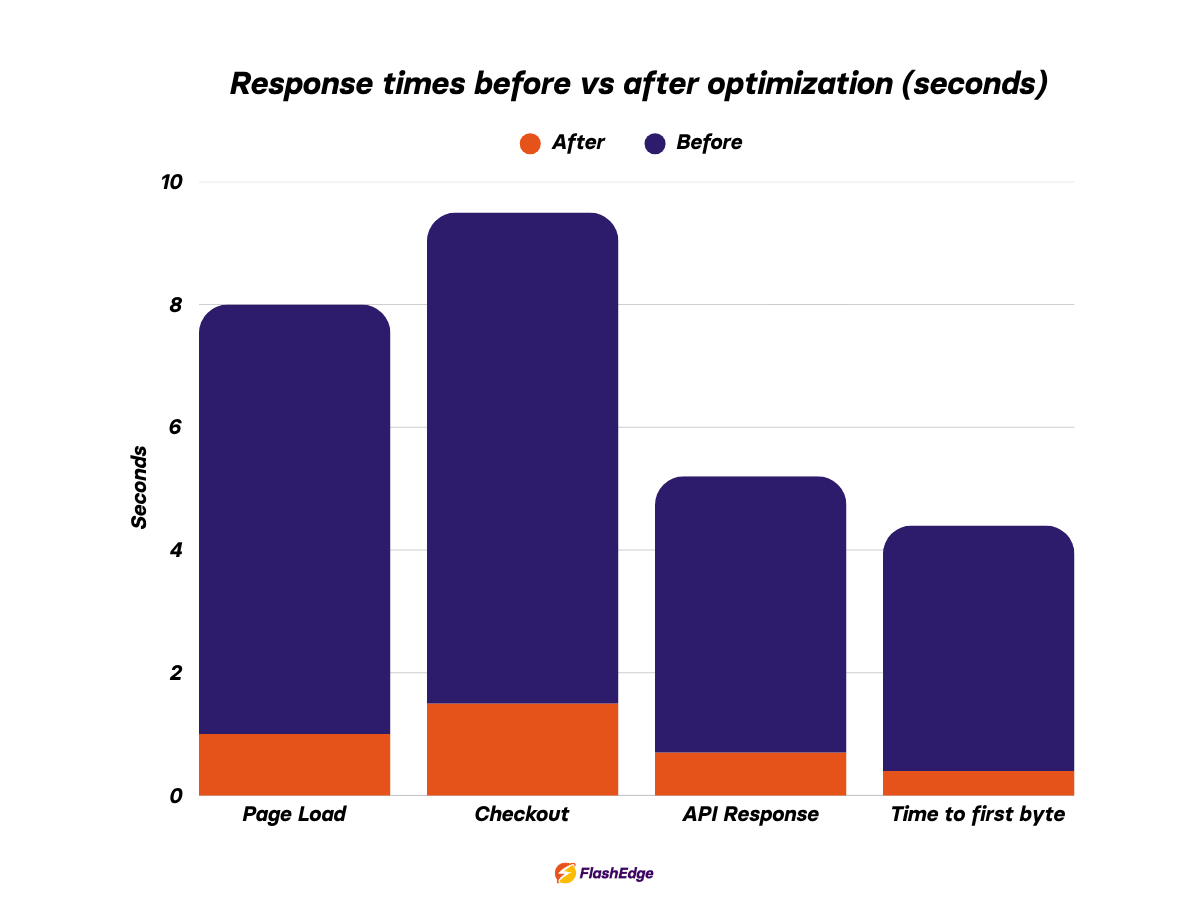
A leading footwear e-commerce brand hit a wall during peak campaigns. Their high traffic website slowed under demand, checkout errors spiked, and revenue started slipping at exactly the wrong time. After rolling out a CDN, tightening caching, and scaling their infrastructure, performance snapped back—pages loaded faster, checkout stabilized, and conversions followed.
👉 Check out the full case study here: Helping a Leading Footwear E-Commerce Brand Accelerate and Monitor Their Global Traffic
Is your high traffic website ready for the next spike?
If your site slows down or crashes during traffic spikes, the root cause usually sits somewhere in delivery, caching, or infrastructure. These issues tend to stay hidden until demand increases.
Here at FlashEdge, we can show you exactly where the problem is—and what to do about it.
What you’ll get:
- A clear view of what’s slowing your website down
- Identified bottlenecks across delivery and infrastructure
- Practical steps to improve performance
- A plan for handling high user traffic without downtime
👉 Book a free consultation
or
👉 Try our CDN with a free trial
Frequently Asked Questions
What counts as a high traffic website?
It generally refers to sites handling large volumes of concurrent users. The exact number depends on how well the system scales.
Why does high traffic on website performance cause slowdowns?
Because server resources get saturated—especially databases and backend services.
How do high traffic sites stay reliable?
They rely on CDN, caching, load balancing, and continuous monitoring.
Can too much traffic on website environments be managed?
Yes, with the right infrastructure and optimization in place.
Do high traffic blog sites need advanced setup?
They do. Even content-focused sites need to handle spikes smoothly to maintain user experience and SEO performance.